
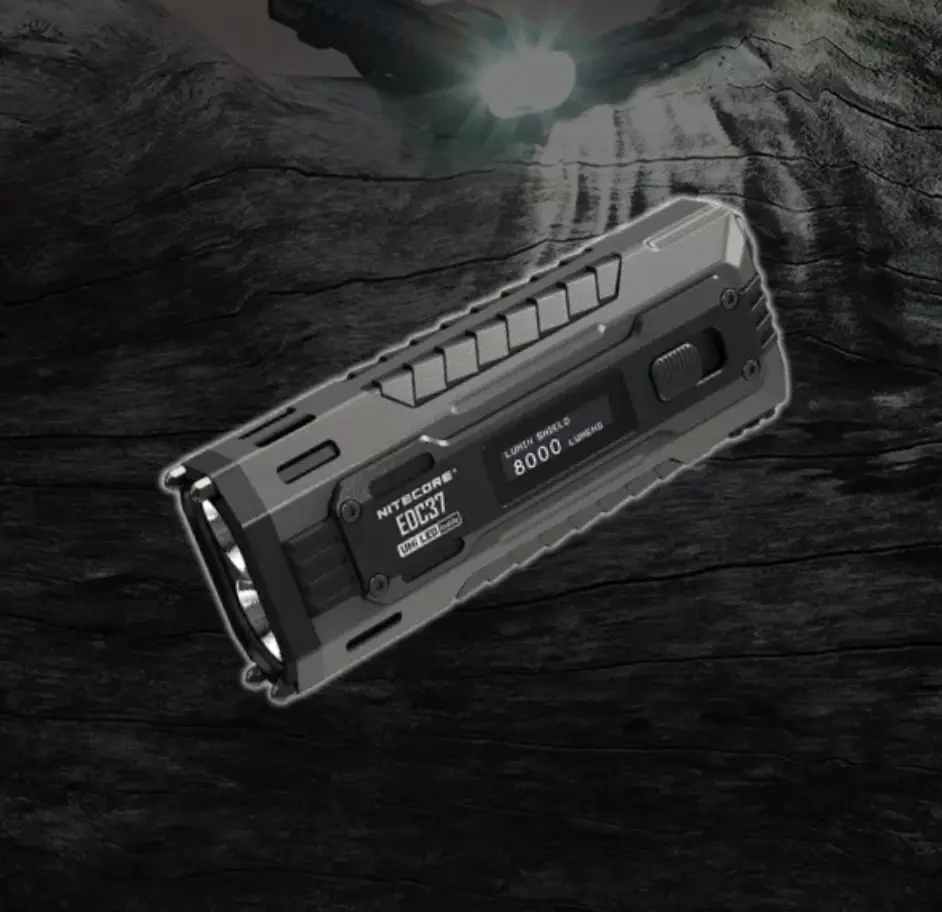
I bought the standard Nitecore EDC37 with my own money for £100. Nitecore supplied no product, trip support, payment or editorial approval. I carried it for three months of camping and hiking through Quebec’s Laurentides, the Gulf of St Lawrence and Saguenay National Park, then used it for night sailing, including a three-night offshore passage.
Quick verdict
The EDC37 is a pocket rocket in the most literal sense: a slim, flat light that disappears against the side of a pocket, yet can throw an almost comical 8,000-lumen wall of light for a few seconds. The excellent tail controls, useful OLED display, strong normal modes and huge internal battery make it much more than a party trick. It is still a 200-gram object, the clip is not true deep carry, turbo heat arrives almost instantly, and IP54 protection is disappointing for outdoor and marine use. The sealed battery is the biggest long-term compromise. For maximum output and gadget appeal in a carryable shape, however, very little feels quite like it.
What works
- Flat body carries far better than a round light with similar capacity
- Extremely powerful 8,000-lumen Lumin Shield burst
- Useful 400- and 1,500-lumen working modes
- Distinct dual tail switches are easy to operate by feel
- OLED gives clear battery, output and runtime information
- Excellent battery life and quick USB-C charging
What to know
- About 200 grams, so you always know it is there
- IP54 means splash-resistant, not submersible
- Search and Lumin Shield step down after roughly 8-12 seconds
- Head becomes very hot during maximum-output bursts
- Physical lock slider can be nudged open in crowded carry
- Internal battery cannot be replaced
The verdict
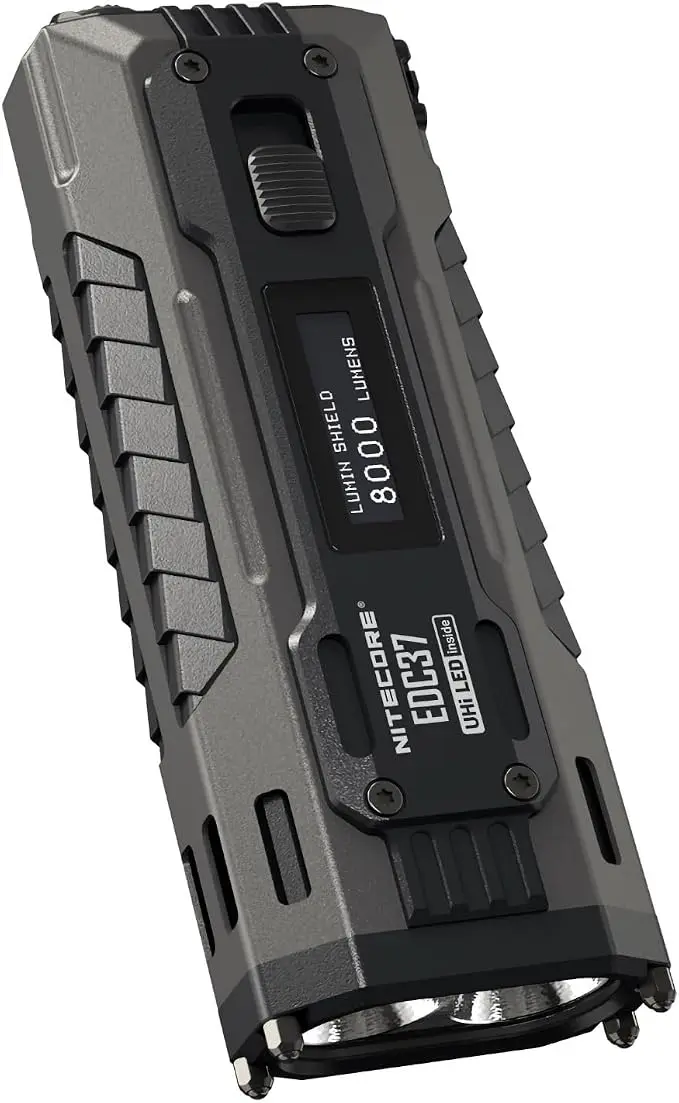
The EDC37 succeeds because Nitecore has not treated the flat shape as a styling exercise. A cylindrical flashlight holding this much battery would make a conspicuous lump and roll around in a loose pocket. The EDC37 sits against the pocket wall more like a thick phone or multi-tool. Its width spreads the weight, the flat sides stop it digging into my leg while seated and the profile stays predictable as I move.
Output is the headline. Search mode reaches across open water and distant treelines, while Lumin Shield throws an overwhelming flood that can wash out a very large area. Both are astonishing from something that fits in one hand. They are brief tools rather than sustainable working levels: heat rises immediately and regulation pulls output down hard. The sensible everyday light is found in the normal steps, particularly 400 lumens around camp and 1,500 lumens when walking, navigating or checking further ahead.
Buy the EDC37 only for the 8,000-lumen number and you may be disappointed by how quickly it steps down. Buy it as a very capable daily light with instant access to a spectacular emergency burst and the design makes much more sense.
How I tested the EDC37
The light travelled with me for three months of camping and hiking in Quebec, including the Laurentides, the Gulf of St Lawrence and Saguenay National Park. Those trips mixed dark campsites, forest paths, open shorelines, navigation checks and ordinary close-range jobs. It also came aboard for night sailing and a three-night offshore passage, where identifying objects on deck, checking rigging and scanning dark water gave the beam a very different job.
Marine use also sharpened my view of the IP54 rating. The EDC37 handled rain and heavy splashes without trouble, but I treated it as splash-resistant electronics rather than a light I could drop in a cockpit or trust after immersion. The IP54 limit deserves much more attention around water than it would for an urban pocket light.

Flat carry, serious weight
Yes, the rectangular profile carries better than a conventional round flashlight. It hugs the side of a pocket and avoids the awkward cylindrical bulge created by a tube with comparable battery capacity. The benefit is obvious from the first day.
It is not a small or weightless EDC light. At around 200 grams, the EDC37 has the presence of a thick smartphone or full-size multi-tool. The factory clip is exceptionally robust, but it lands closer to the centre than a true deep-carry clip, leaving part of the tail exposed. In looser trousers the width and weight can shift, especially if the waistband is not secure.
The flat sides remain comfortable when sitting and do not press a narrow tube into the leg. I would happily carry it in a proper pocket, jacket or bag; people used to tiny keychain lights may find it excessive.
Controls and physical lockout
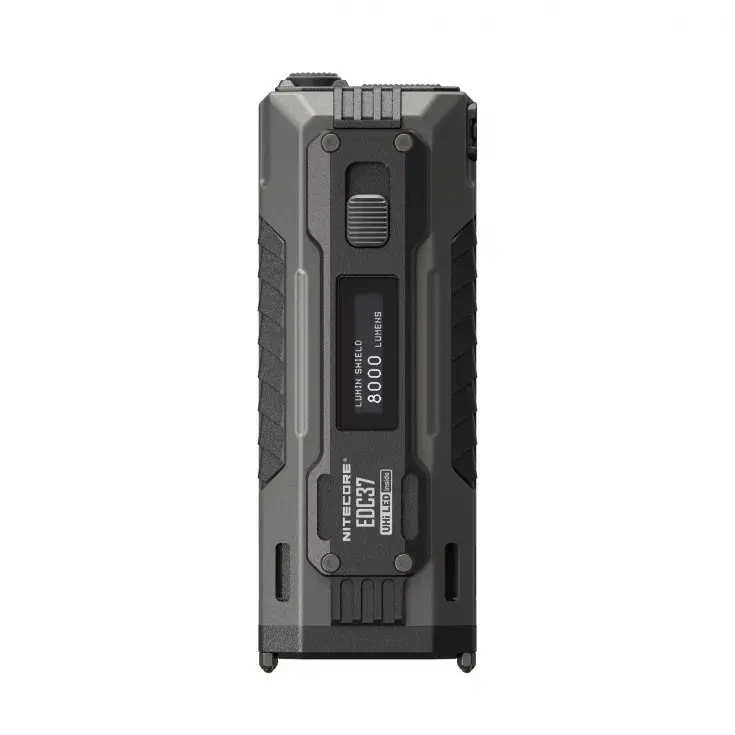
The controls are unusually easy to understand. A round primary tail switch handles power and the normal output cycle. Beside it, a flatter, wider secondary switch gives direct access to Search and Lumin Shield. Their different shapes are easy to distinguish by thumb in total darkness or while wearing gloves.
Separating the burst modes from the normal cycle cuts down wrong-output mistakes. There is no need to click through low and medium settings when you suddenly want distance or flood. Within a few minutes the interface feels natural.
The physical lockout is better than memorising an electronic click sequence. Slide it into the locked position and power is cut immediately. It also needs to be used: left unlocked, crowded pocket or belt carry can create accidental activation. The rapid slider prevents most mishaps, but its exposed position means aggressive rubbing against other kit can occasionally nudge it back toward unlocked.
Normal illumination and beam quality
Mid at 400 lumens and High at 1,500 lumens did most of the work. Four hundred lumens is enough for camp chores, walking and close navigation without burning through the battery. The 1,500-lumen level is sustainable, reaches usefully further and has enough punch for fast checks across open ground.
The 15-lumen Ultralow mode is excellent indoors and around camp. It preserves night adaptation, gives enough light to read small print and lets you move around without waking or dazzling everyone nearby.
Nitecore’s UHi 20 MAX multi-core emitter setup creates a useful hybrid beam. The centre is defined and intense enough for distance, while broad, smooth spill illuminates the immediate path and peripheral area. At close range against a plain white wall, minor geometric artifacts from the bezel can appear in the spill. In real outdoor use they are mostly irrelevant.
Colour is functional cool white with low colour rendering. It looks clean and efficient, not warm or especially natural. If accurate colour identification or a pleasant campsite tint matters more than sheer output, this is not the EDC37’s strongest area.
Search and Lumin Shield
The claimed maximum output feels meaningfully different from an ordinary flashlight. Lumin Shield’s 8,000 lumens turn darkness into a bright wall for a moment, while Search mode concentrates the available punch for distant trees, shorelines, water and boundaries. On the boat, Search was the more practically useful shortcut. On land, Lumin Shield made immediate surroundings impossible to ignore.
Lumin Shield can be a spectacular party trick, but the emergency use is real. A huge flood can disorient someone, reveal a broad area instantly or create time to understand a confused scene. It also destroys your own night vision if used carelessly. Bounce it from a white wall, road sign or cabin surface at close range and the glare comes straight back.
Expect roughly 8 to 12 seconds before a major output reduction, depending on ambient temperature and how warm the light already is. The display’s step-down countdown helps set expectations. You can request full output again, but a hot body will trigger protection until it has shed enough heat.
Heat and output reduction
The head becomes hot almost immediately in Search or Lumin Shield. Holding lower on the body keeps fingers away from the worst of the thermal spike, using the battery mass and frame as separation. Choke up toward the emitters and it can become uncomfortable quickly.
The automatic reduction is obvious on burst output: brightness drops hard once thermal limits are reached. Regulation is far less intrusive on normal levels, which reinforces the difference between the EDC37’s working modes and its emergency party piece.
Battery and USB-C charging
Runtime in normal use was excellent. With most jobs handled at 400 or 1,500 lumens, the integrated battery lasted through days of regular use and weeks of casual carry without creating range anxiety. Weekly or fortnightly top-ups were enough unless I repeatedly demonstrated the maximum burst.
A full USB-C charge took roughly two hours with a capable PD/QC charger. Both USB-A-to-C and C-to-C cables worked reliably with ordinary chargers and power banks. The live percentage display is far more useful than decoding a flashing indicator LED.
The sealed battery is still the single biggest design compromise. Capacity and slim packaging are excellent now, but lithium cells degrade. Years from now, a tired battery may turn an otherwise durable aluminium light into electronic waste instead of accepting a fresh field-swappable cell.
OLED display
The screen earns its space. It shows battery percentage, the active lumen tier, remaining runtime and a live countdown when extreme output is about to reduce. Runtime estimates respond as modes change and were reasonably representative in use.
Direct midday sun can wash it out, but normal daylight, overcast weather and indoor conditions present no problem. On a technical light with multiple regulated outputs, the display removes uncertainty rather than adding clutter.
Build quality, water resistance and glass breakers
The aluminium body feels rigid, industrial and precisely assembled. Coatings resisted normal pocket wear during the test, the charging-port flap remained tight and the display survived minor scuffs. The exposed lock slider can collect pocket lint, but controls stayed secure.
IP54 protection is the weak point for serious outdoor use. Rain and heavy splashing were fine; submersion is not. Anyone working around boats, paddling, caving or relying on a light in sustained wet conditions should choose a model rated for submersion.
The pointed silicon-nitride tips at the front are ceramic glass breakers. Few owners will ever break a window with them, but they also work as stand-off bezels and keep the lens face from sitting flush against a surface. If they look or feel too aggressive, Nitecore includes flat replacement screws in the box.
Who should buy it
The EDC37 makes most sense for tech enthusiasts, urban EDC users and anyone who wants extraordinary instant output in a flat package. It is also a compelling secondary light for campers, hikers and sailors who value strong normal modes, long battery life and the ability to scan a distant treeline or patch of water.
Avoid it if you need submersion protection, a field-swappable battery or a lightweight pocket light. Those are significant limitations that determine whether the EDC37 is the right tool. For the right owner, the combination of flat carry, intuitive controls and very high output works well.
Nitecore EDC37 test details
| Tested model | Standard Nitecore EDC37 |
|---|---|
| Peak output | 8,000 lumens in Lumin Shield |
| Frequently used modes | Mid, 400 lumens; High, 1,500 lumens |
| Lowest mode | Ultralow, 15 lumens |
| Approximate weight | About 200 g |
| Water resistance | IP54, splash-resistant |
| Charging | USB-C; roughly two hours for a full charge |
| Battery | Integrated, non-replaceable lithium battery |
| Price paid | £100 |
| Test period | Three months |
| Conditions | Camping and hiking in Quebec; night sailing and a three-night offshore passage |
| Manufacturer involvement | None. No free sample, trip support, sponsorship or copy approval. |
Scoring breakdown

Sources & context
What we checked
This review is grounded in Adam’s three months of field use across Quebec and on night sailing passages. Carry, controls, runtime, heat, beam performance and durability observations come from that use.
Editorial disclosure: Adam bought this Nitecore EDC37 with his own money for £100. Gear Reviews received no payment, free product, trip support or editorial approval from Nitecore.