

We are snobby about flashlights. Olight, Klarus, Fenix and Nitecore have made four-figure lumen claims feel ordinary, so the Distance LT 1100 did not win us over with its maximum output. It did so while running downhill: the light stayed exactly where it was aimed, the foreground remained visible and the beam did not bounce with every footfall.
Gear Reviews bought the Black-Alloy Distance LT 1100 for US$140. Black Diamond did not supply it, fund the testing, approve the article or know the review was taking place. Adam Whistler used it over three months and 90 nights of camping, hiking and occasional running in Quebec's Parc national des Hautes-Gorges-de-la-Rivière-Malbaie, Saguenay National Park and the Gulf of St Lawrence.
Quick verdict
The Black Diamond Distance LT 1100 is a purpose-built technical-running headlamp whose strongest qualities are stability and optical control, not a spectacular lumen figure. Its pivoting light engine lets the battery housing remain flush against the forehead, while the lens combines a useful central spot with broad flood illumination. PowerTap adds a ten-second 1,100-lumen route-finding burst, sustained high delivers 600 lumens, and IP67 sealing suits foul weather. The complex interface, hot housing, absent rear safety light and awkward spare-battery charging keep it from a higher score.
What works
- Pivoting light engine eliminates bounce without overtightening
- Spot and flood blend provides excellent depth perception
- PowerTap gives immediate 1,100-lumen route-finding light
- 600-lumen high mode ran for just over four hours
- IP67 sealing handles dust, rain and accidental immersion
- Low-profile band remains comfortable for long sessions
What to know
- Interface relies on memorised presses and double-clicks
- Spare battery cannot charge without the lamp attached
- No rear red safety light for road running
- Housing becomes hot during repeated boost or extended high use
- PowerTap can trigger when a hood or thick glove brushes it
- RGB modes add complexity beyond the useful red option
The verdict
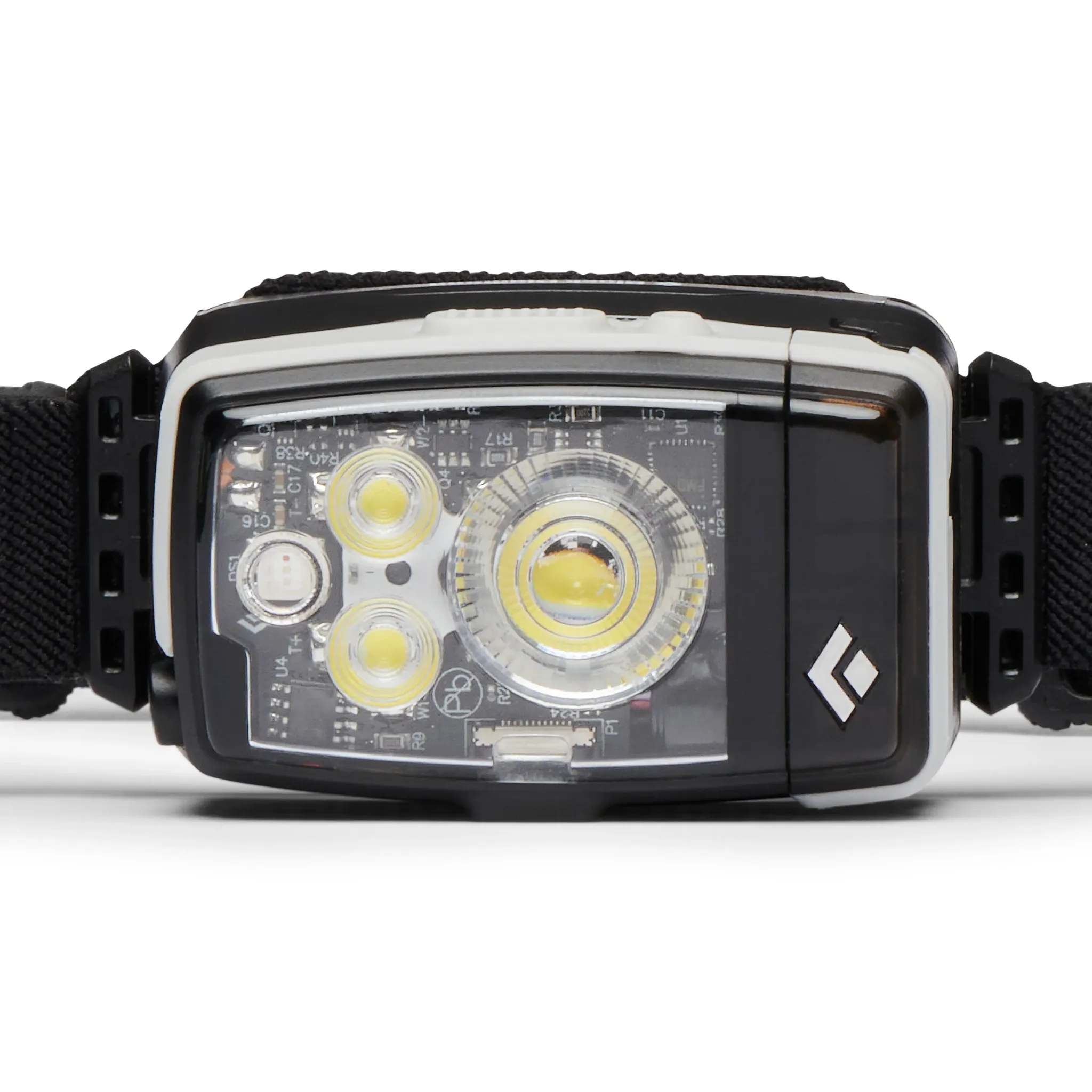
The Distance LT 1100 is one of the best headlamps we have used for moving quickly over technical ground. Trail runners, ultrarunners, fastpackers and alpinists should care because it solves the problem that ruins many powerful headlamps: the heavier the lamp, the more firmly it must be strapped down to stop its beam bouncing. Black Diamond keeps the 2,200 mAh battery and main housing close to the forehead, then pivots only the slim optical assembly. It stays still without turning the headband into a vice.
The beam is equally important. A focused centre reaches down the trail while broad, even spill illuminates roots, rocks and the space beside your feet. There is no hard tunnel of light surrounded by darkness, so peripheral awareness and depth perception remain intact. The 1,100-lumen boost makes distant markers and route edges visible, but it lasts ten seconds by design. A sustainable 600-lumen high mode is the setting that defines real night-running performance.
Casual campers can spend less, and long-distance hikers who depend on batteries available from a gas station may prefer a simpler AAA-compatible lamp. The Petzl Nao RL adds reactive lighting and a rear battery; Silva's Trail Speed family is more modular but bulkier; Black Diamond's Storm line is cheaper and easier to understand but less composed while running. At the US$140 we paid, the Distance LT 1100 is expensive but worthwhile for people who will benefit from its optics and stability. It earns 4.5 out of 5.
How I tested it
The headlamp lived in a running vest or camping kit for three months across exposed coastline, forest trails and steep park terrain. Ninety nights gave it jobs ranging from reading and cooking to finding routes, walking technical ground and running rocky descents. It saw rain, fog, cold, sweat and dust, and it was dropped, knocked against granite and compressed beneath other equipment.
Runtime observations came from practical use rather than a laboratory integrating sphere. High remained useful for just over four hours; medium reached about 14 hours across longer sessions; low was consistent with Black Diamond's 120-hour maximum claim. Beam distance was judged against identifiable trail features and reflective markers. We did not test battery degradation over hundreds of cycles or deliberately perform a controlled immersion test.
The pivot that stops bounce
The independent lens pivot sounds like a small mechanical detail until the terrain becomes rough. Conventional headlamps tilt the complete lamp body, moving battery mass away from the forehead and increasing leverage with every stride. Here, the broad rear plate and battery remain flat while only the low-mass light engine changes angle. The effect is almost gimbal-like.
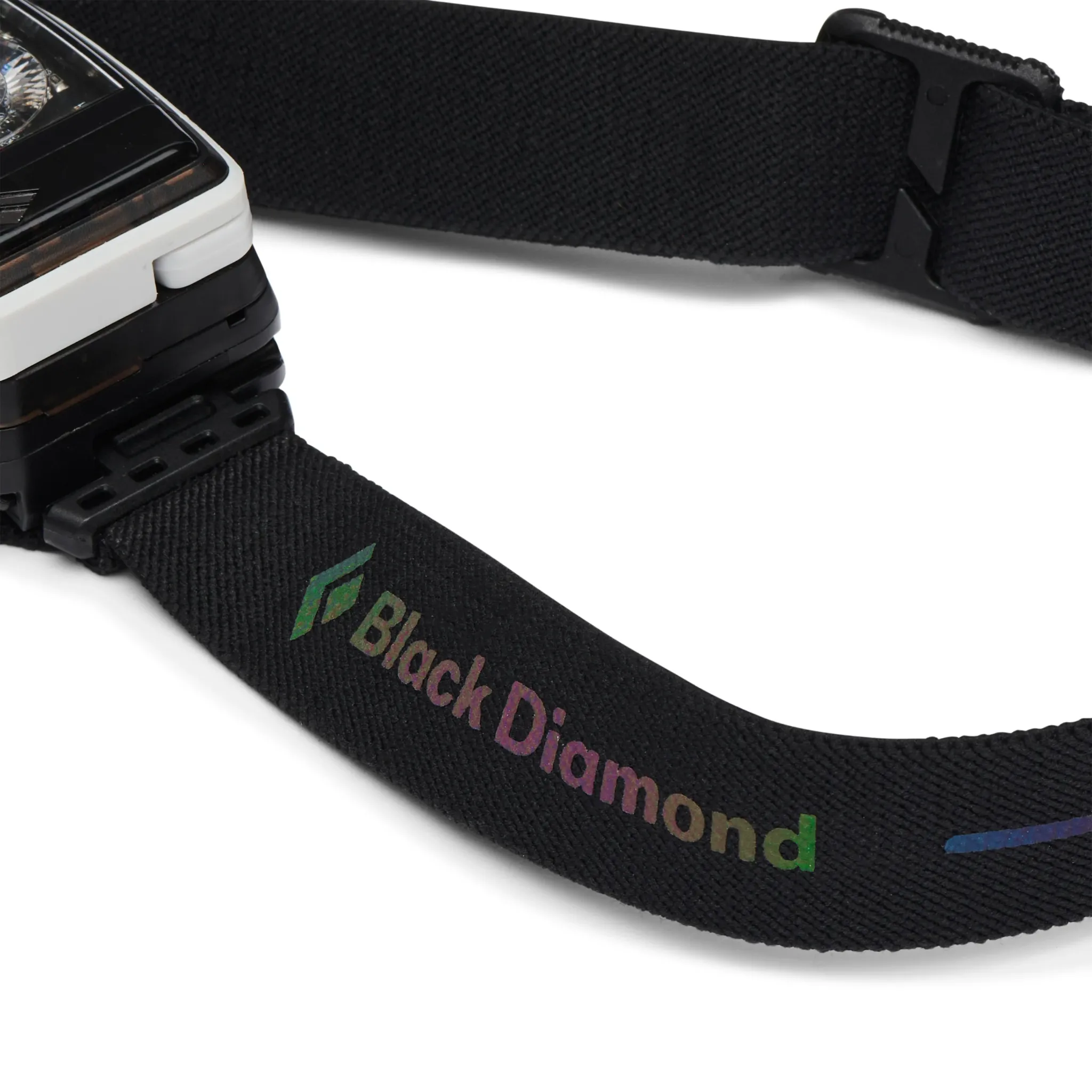
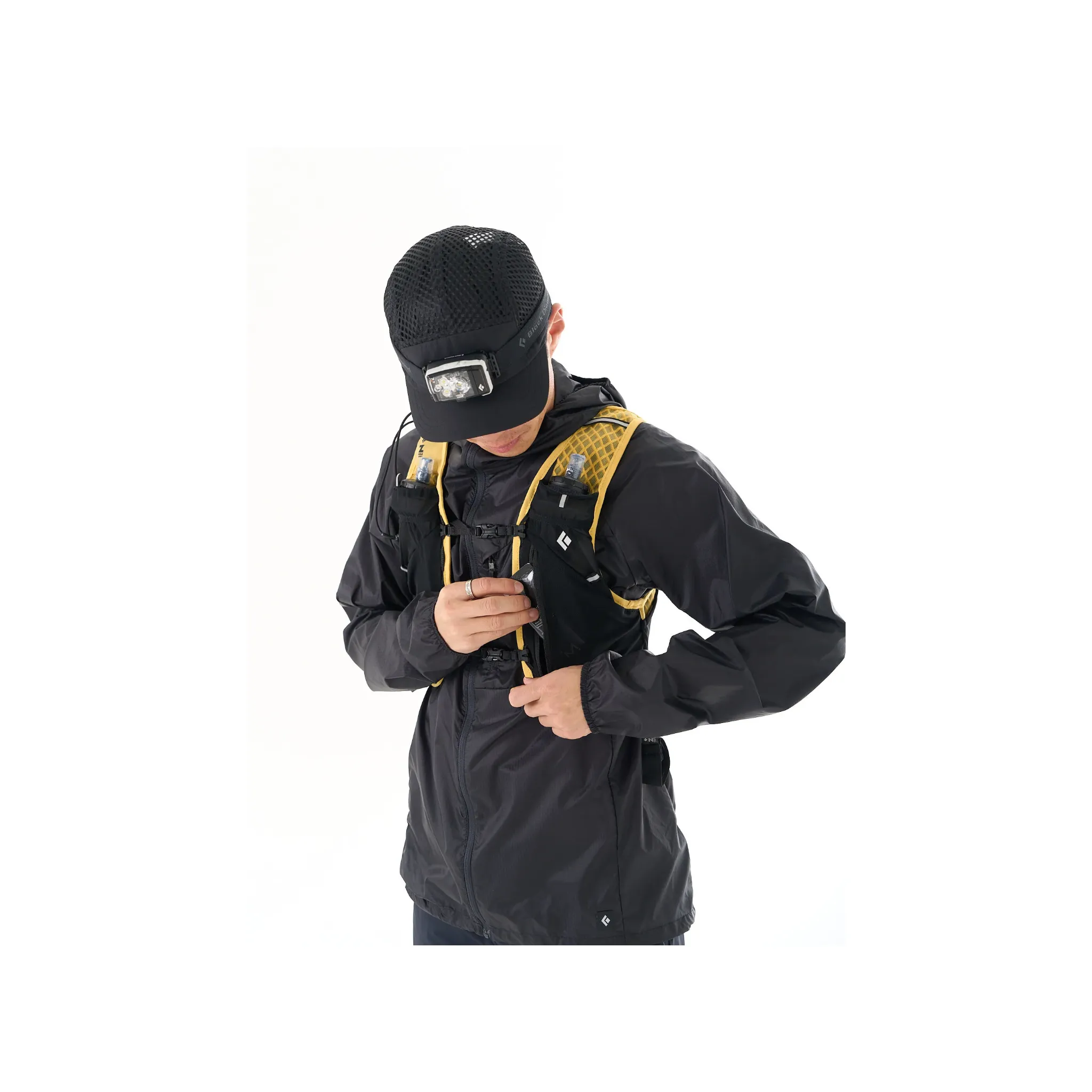
Bombing down rocky trail, jumping and traversing uneven ground did not shift the beam. The hinge retained its chosen angle, and the band did not need headache-inducing tension. A curved backplate spreads pressure cleanly; the suspended band breathes and dries quickly. With no rear battery or cable, it also avoids collars and pack straps and stretches naturally around a cap or climbing helmet.
Beam quality on technical ground
Enthusiast flashlights can produce far more than 1,100 lumens, yet total output is a crude measure of usefulness on the head. The Distance's optical design distributes its light with unusual discipline. A long-reaching spot defines the route while a broad flood reveals the ground immediately ahead. There were no distracting dark rings, colour fringes or hard transitions in ordinary use.
That balance helps the brain read texture. Mud, roots, stones and drops remained distinct while moving quickly, without the dizzy tunnel vision created by a narrow hotspot. Colour rendering looked natural enough to separate surfaces reliably. In rain, the beam retained useful reach. Fog and blowing snow reflected 600 lumens back toward the wearer, but smooth dimming made it easy to reduce glare rather than accept a rigid preset.
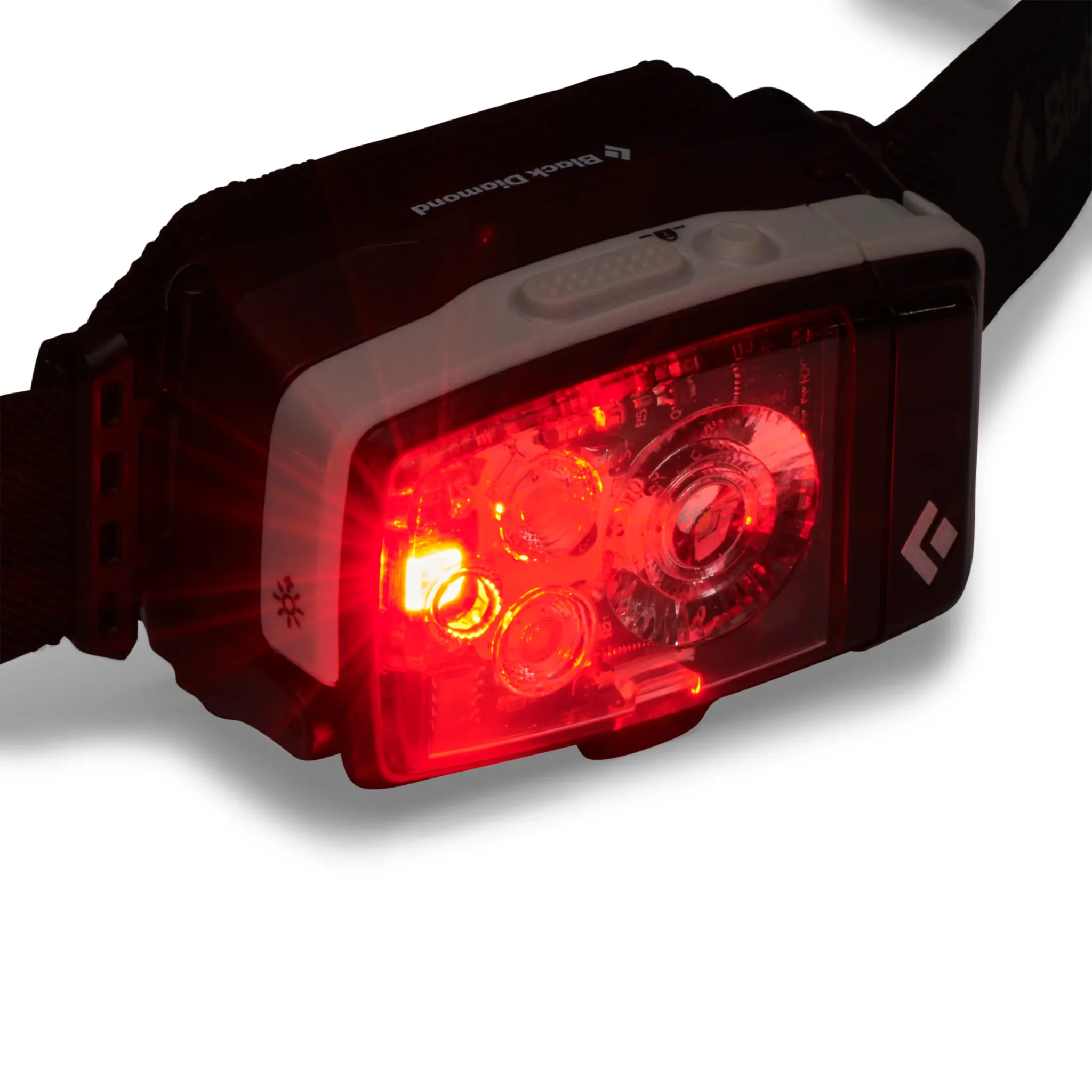
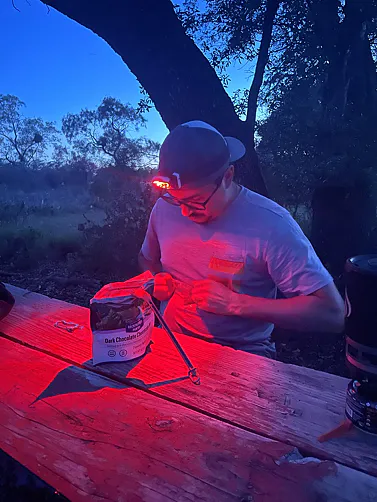
For hiking, approximately 300 lumens was enough. Seven lumens worked for reading and close camp tasks without dazzling a companion. The red mode preserved night adaptation, while green and blue added little to our use. On a helmet it made a good cycling backup, though the missing rear red lamp means it is not a complete road-safety system.
PowerTap and sustained output
Touching the side housing triggers a 1,100-lumen boost and returns to the previous setting after ten seconds. Black Diamond publishes a maximum beam distance of 125 metres in PowerTap mode; outdoors, reflective markers and major terrain features were easy to identify beyond 100 metres. It is a route-finding tool for checking the far side of a junction or locating an edge, not a continuous operating mode.
That distinction prevents the headline from becoming misleading. High is 600 lumens, with a published reach of 110 metres and 4.25-hour runtime. Our lamp remained at a useful high output for just over four hours before visibly reducing output to preserve the remaining charge. Repeated PowerTap activation makes the housing hot, and extended high use on a still night also raises its temperature. Automatic control and the ten-second boost limit manage the heat, but the surface can still become uncomfortable to touch.
PowerTap was dependable in rain and fast to reach with a gloved hand. Rain itself did not activate it. A hood passing over the lamp and a careless winter glove occasionally did. Those accidental bursts were brief, but they matter around companions whose eyes have adjusted to darkness.
Controls and coloured modes
The main button is raised enough to locate in darkness, and holding it gives smooth output adjustment from 7 to 600 lumens. Brightness memory returned to the previous white setting after shutdown. The digital lockout, engaged with both buttons, reliably prevented the lamp from switching on in a pack.
Beyond those basics, the interface is overcomplicated. Red, green, blue, SOS and strobe functions depend on long presses and click combinations that are easy to forget between trips. A mistaken sequence while looking for red light can produce a startling white strobe. Serious users will learn the pattern; an emergency tool should demand less recall.
Battery, runtime and charging
The removable lithium-ion battery holds 2,200 mAh at 3.7 volts. High ran for just over four hours in our use, medium pushed to roughly 14 hours and low suits multi-night camp use. Cold shortened runtime slightly, as expected, but the battery's position against the warm forehead reduced the exposure suffered by an external rear pack. Blue indicator LEDs gave a dependable sense of remaining capacity, and output declined gradually rather than ending in an abrupt blackout.
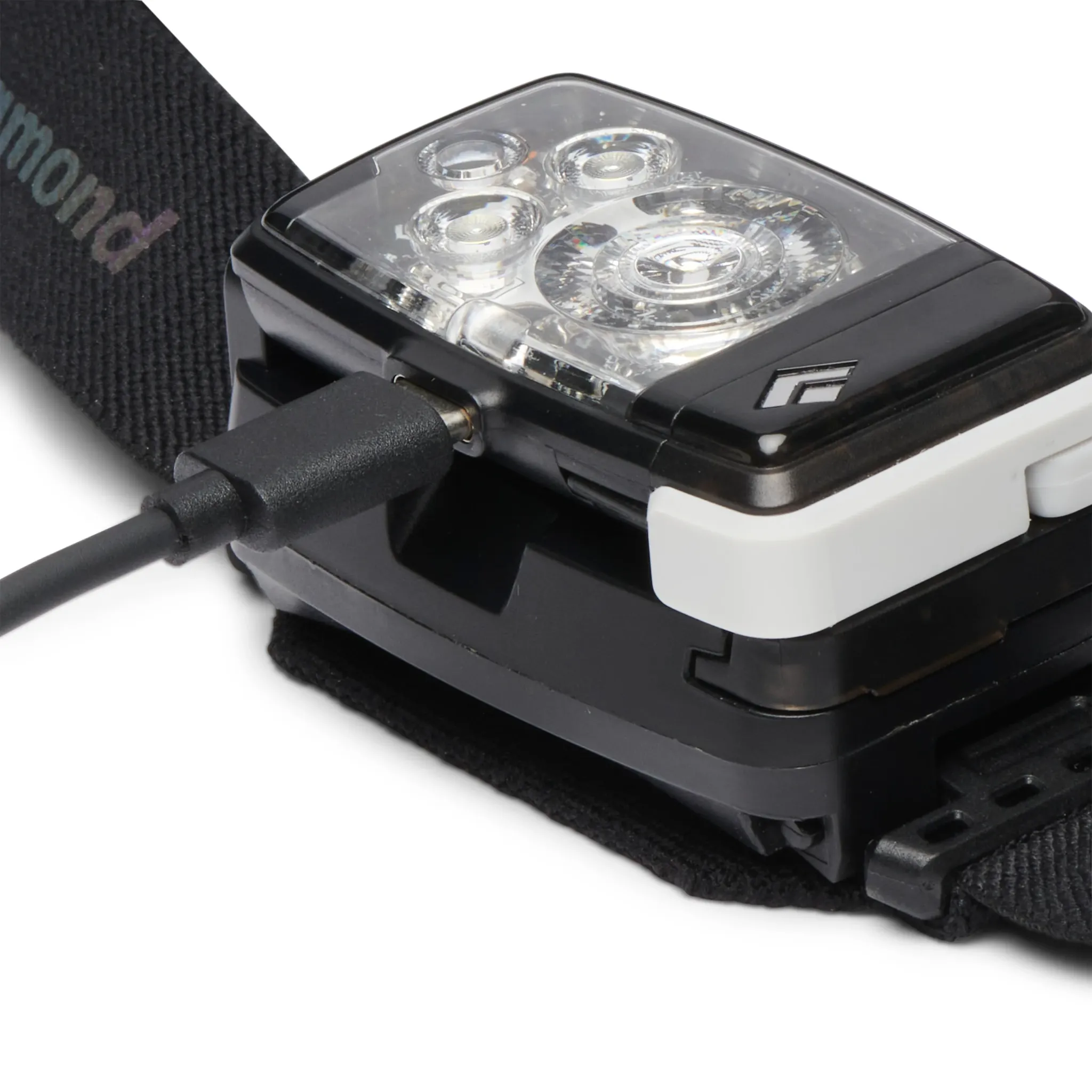
Charging takes a few hours over USB-C, and the lamp can run while connected to a power bank. The design of the charging path is the larger problem. The USB-C socket sits on the light housing, not on the removable battery, so a spare cannot charge while the lamp is attached to another battery and in use. Running a cable from the forehead to a pocket is possible but awkward. A small external battery charger or a USB-C port on each pack would make the removable system far more useful during ultras and multi-day trips.
Weather protection and durability
Black Diamond rates the sealed housing IP67, meaning dust protection and resistance to immersion in one metre of water for 30 minutes under the standard test conditions. We confirmed reliable operation through sustained rain and wet controls, but did not deliberately repeat the laboratory immersion test. Sweat caused no visible internal condensation.
Three months of granite scrapes, drops and careless packing produced dirt on the strap but no visible damage to the lens, housing, hinge or cable. Nothing loosened or stretched. IP67 protection is especially reassuring for runners crossing exposed terrain because a dropped lamp in a puddle need not become a trip-ending failure.
Value and alternatives
At US$140, this is not the economical answer to finding a tent zip. The money buys an unusually stable mechanical layout, strong optics, weather sealing and sufficient runtime for serious night movement. Those qualities remain useful long after the novelty of PowerTap has passed.
Petzl's Nao RL is the alternative for runners who value reactive lighting and a rear-mounted battery. Silva's Trail Speed family offers greater modularity at the cost of bulk. Black Diamond's Storm models suit campers who want lower prices and simpler ownership, but they do not match this lamp's bounce control at speed. Enthusiast handhelds from Olight, Klarus, Fenix and Nitecore offer far higher headline output, yet they cannot place a blended, steady beam wherever the runner looks.
We will keep the Distance LT 1100 for night trail sessions and ultras. A future model with a rear safety LED, simpler colour controls and independently chargeable batteries would be harder to fault. Until then, this is a specialised lamp whose specialisation produces a real advantage.
Black Diamond Distance LT 1100 specifications
| Price paid | US$140 |
|---|---|
| Colour | Black-Alloy |
| Published weight | 108 g |
| PowerTap output | 1,100 lumens for 10 seconds |
| Sustained high | 600 lumens |
| Minimum output | 7 lumens |
| Published beam distance | 125 m PowerTap; 110 m high; 58 m medium; 8 m low |
| Battery | Removable 2,200 mAh, 3.7 V lithium-ion pack |
| Published high runtime | 4.25 hours at 600 lumens |
| Published maximum runtime | 120 hours |
| Charging | USB-C port on lamp housing |
| Weather rating | IP67 |
| Additional LEDs | Red, green and blue |
| Rating | 4.5 / 5 |
Overall score: 4.5 out of 5. The Distance LT 1100 combines the best stability we have experienced in a running headlamp with a superb spot-and-flood beam. Its interface and battery-charging design are the main weaknesses.

Sources & context
What we checked
Gear Reviews bought this headlamp for US$140. Black Diamond had no involvement in the test or article. Published specifications and operating limitations were checked against the manufacturer's current documentation.
Editorial disclosure: We bought the headlamp with our own money. Black Diamond did not provide it, fund the test, see the copy or know the review was taking place.