
I bought the current Jetboil Flash 1.0L with my own money for £130 and used it through a 90-day hiking trip in Quebec. Jetboil did not provide the stove, pay for the trip or know this review was being written. Most of its work involved making coffee around the Laurentides, the Gulf of St Lawrence and Saguenay National Park, with camping meals joining in when required. The test was narrow because the Flash itself has a narrow purpose: boiling water quickly.
Quick verdict
The Flash is a superb water boiler for hikers who value speed and tidy packing. On cold mornings, a mug's worth of water can be ready in roughly 100 seconds. The burner, stabilizer and a 100 g fuel canister all nest inside the one-litre cup, and the thermal indicator removes guesswork. The tall assembled system needs its orange tripod feet, wind performance has limits, and mine developed the familiar Jetboil party trick of a piezo igniter that only works when it feels like it. Simmer control is poor. Coffee drinkers and dehydrated-meal users will forgive most of that; camp cooks should choose a wider, more controllable stove.
What works
- Exceptionally fast boil times
- Burner, stabilizer and 100 g canister nest inside
- Twist-and-lock cup connection feels secure
- Thermal indicator is useful
- FluxRing handles light wind well
- Insulated sleeve makes the cup easier to handle
What to know
- Piezo igniter became unreliable
- Very limited simmer control
- Tall one-litre setup feels precarious without the stabilizer
- Lid can soften and lift under heavy steam
- Drinking spout invites burned lips
- Poor fit for frying, sautéing or proper pan cooking
The verdict
The Jetboil Flash makes sense once its job description is kept short. It boils water fast, using a system that packs neatly and sets up in seconds. Roll out of a tent at 6am with cold hands and very little patience, then having hot water for coffee before your brain has fully joined the day feels close to magic.
That pace comes with a narrow cooking range. The burner gives little usable space between off and hard boil, while the tall integrated cup is built around water rather than food. It will rehydrate a pouch, fill a cafetière or make instant noodles. Frying an egg, sautéing vegetables or holding a sauce at a gentle simmer becomes awkward.
My score treats that specialisation as a design choice, while the failed piezo remains a straightforward fault. A £130 stove should keep lighting itself. Carrying a lighter solved the practical problem, but it also removed one of the conveniences I had paid for.
How I tested the Jetboil Flash
The Flash travelled as part of my kit for 90 days in Quebec. I used it around the Laurentides, along the Gulf of St Lawrence and in Saguenay National Park, mainly to make coffee during hiking days and while camping. It saw chilly starts, damp camps, exposed stops and the ordinary knocks of being unpacked and repacked for three months.
Coffee was the main event, which suits this system unusually well. I also used it for basic camp food where the instruction begins with adding boiling water. I did not pretend it was a frying pan or force it through elaborate meals just to prove a point.
The comparison in my head was a Trangia used on an earlier trip. The Trangia took its time but could cook a proper meal with far more control. The Flash occupies the other end of the stove drawer: quick, focused and almost impatient.
Packing and setup
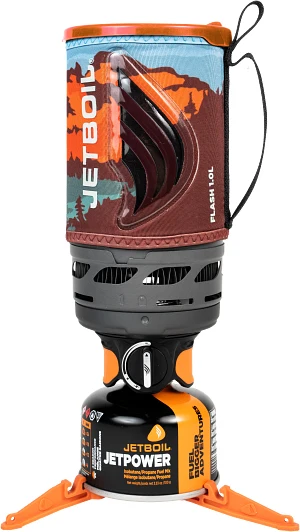
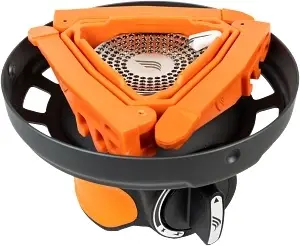
The nesting arrangement is one of the best reasons to own a Flash. A 100 g fuel canister, the burner head and the orange stabilizer fit inside the cup. The bottom cover and lid close around the lot, producing a single package that slips into a rucksack without loose stove parts migrating through the luggage.
There is a correct little puzzle to packing it. Get the pieces in exactly the right orientation and they sit quietly. Throw them in carelessly and the Flash rattles like a maraca with every step. After a few days the arrangement becomes muscle memory, although it is still possible to get it wrong during a rushed morning.
Assembly is simple. Screw the burner onto the canister, spread the stabilizer feet, then place the cup over the burner and twist until the three locking points engage. The connection feels solid once seated. It is important to check that engagement because a poorly positioned cup can damage or scorch the insulating sleeve.
The orange tripod is a compulsory part of my setup. With a full litre of water sitting above a small fuel canister, the whole tower carries a high centre of gravity. The stabilizer makes a big difference, but I would still choose level ground and keep feet, elbows and wandering children away from it.
Boil speed and fuel efficiency
Jetboil quotes an average boil time of 120 seconds for half a litre over the life of a canister. My usual coffee quantity could reach a full boil at around the 100-second mark in favourable conditions. Exact times changed with water temperature, fuel level and weather, yet it stayed meaningfully faster than the conventional camp stoves I have used.
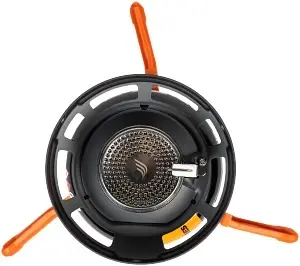
The FluxRing under the cup captures heat that would otherwise spill around the sides. Over a long trip, repeated coffee stops consume less fuel and demand less waiting. Jetboil states that a 100 g JetPower canister can boil about ten litres under its test conditions. Real mileage moves around with wind and temperature, but the system never felt wasteful.
Speed also changes how often you use a stove. I was more willing to make coffee during a short pause because the interruption was so small. There was no extended priming routine or long watch over a reluctant flame. Click, twist, boil, drink, pack.
Wind performance and stability
The shrouded burner and FluxRing cope well with a light breeze. They protect the flame better than an exposed upright burner, and ordinary campside air movement rarely stopped the boil. A properly windy ridge still wins. In those conditions I looked for natural shelter rather than demanding a miracle from a small gas stove.
Improvised foil windscreens require caution around this type of canister-mounted system. Wrapping one tightly can trap heat around the canister and plastic components. I avoided that approach and followed the manufacturer's setup, moving behind a rock or other safe natural barrier when wind became a nuisance.
Stability is the bigger daily concern. The locked cup will not casually slide off the burner, which is excellent, but the whole assembly can still topple as one unit. The stabilizer reduces that risk without making the stove invulnerable. A litre of boiling water deserves a clear, flat operating area every time.
The piezo igniter problem
The push-button igniter is wonderful while it works. Turn the gas control, press the button and the burner starts without matches or a separate lighter. Mine eventually stopped producing a reliable spark. Sometimes it lit after several presses; sometimes it refused completely.
I know several Flash owners who have met the same problem, although that is anecdotal rather than a failure-rate study. My own unit is enough to affect the durability score. A basic lighter became part of the stove kit, and once carried it made the failed piezo more irritating than trip-ending.
The unreliable ignition system can leave you reaching for the same disposable lighter that would start a £20 burner. Carrying a backup lighter prevents it from delaying breakfast.
Cup, sleeve and lid
The neoprene-style insulating sleeve makes the hot cup manageable and helps retain heat. Its thermochromatic indicator turns orange as the water approaches boiling. This could have been a novelty; in practice it saves constant lid lifting and tells you when to get the coffee ready.
The sleeve sits close to the burner, so the cup must be locked into its proper position. Seat it badly and heat can reach the fabric. I managed to avoid serious damage, but the possibility adds another reason to slow down for the final twist even though the rest of the process is fast.
The flexible lid presses on easily and pours reasonably well. At a vigorous rolling boil, steam can soften it enough to make it lift or pop loose. I learned to reduce the flame or switch off as soon as the indicator showed the water was ready.
The drinking spout did not win me over. Sipping near-boiling coffee through a plastic slit on top of a metal cup is an efficient route to burned lips. I poured into a separate mug instead, which adds one small item but produces a much more civilised morning.
Cooking range and simmer control
The Flash can technically heat more than water, but its control range discourages ambitious cooking. The burner wants to run hard. Finding and holding a low flame is fiddly, and the narrow cup is unpleasant to stir or clean after anything sticky. Food can catch at the bottom before the rest heats evenly.
For dehydrated meals, the limitation disappears because the stove only supplies boiling water. The same applies to instant coffee, tea, porridge pots and noodles. Fast-and-light hikers who already eat this way get almost the full benefit of the system with very little compromise.
Campers who enjoy cooking should look at a conventional remote or canister-top stove paired with a wider pan. That setup will take longer to boil and may pack less neatly, but the controllable flame and open cookware choice are far better for actual recipes.
Durability after 90 days
The cup, FluxRing, burner connection and stabilizer all survived the trip without structural trouble. The sleeve picked up normal handling marks, and the plastic pieces remained secure. Packing everything inside protected the burner from being crushed by other gear.
The igniter failure is the durability story. The stove continued to work with a lighter, so the core burner never left me without hot water. Still, an integrated convenience that fails within one trip is disappointing. I scored durability at 3.7 because the main heating components remained dependable while the built-in ignition did not.
Weight, price and value
Jetboil lists the Flash system at 371 g, excluding the 27 g stabilizer. Add a fuel canister and the full cooking package is heavier than the smallest ultralight burner and titanium mug combination. That comparison misses some of the convenience: the Flash includes the insulated one-litre cup, heat exchanger, lid, bottom cover, ignition and a very fast, efficient burner.
At £130, value depends heavily on routine. Someone boiling water twice a day for coffee and dehydrated food will use its speed constantly. Someone cooking one elaborate evening meal will pay for performance they barely need, then fight the lack of simmer control.
Who should buy it
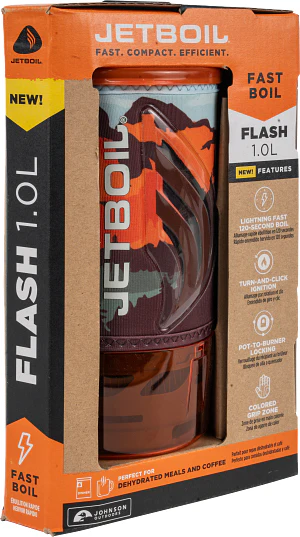
The Flash suits hikers who start the day with coffee, eat add-water meals and care more about boil time than culinary range. It is also strong for short stops in cold conditions, when waiting several extra minutes feels much longer than it sounds. Solo users and pairs are the natural audience.
It is a poor match for campers who sauté, fry, simmer sauces or cook for a larger group. A conventional stove with a broader pot support and finer control will feel less restrictive. People chasing the lightest possible kit can also beat the Flash on weight, although they give up its integrated convenience and efficiency.
I would take it again for the same Quebec trip. The compact packing, rapid boil and thermal indicator made daily coffee easier, and that benefit arrived almost every morning. I would also pack a lighter from day one, use the stabilizer without exception and pour the coffee into a proper mug. Within those boundaries, the Flash is excellent at what it was built to do.
Jetboil Flash 1.0L specifications
| Tested model | Current Jetboil Flash 1.0L Fast Boil System |
|---|---|
| Manufacturer system weight | 371 g / 13.088 oz, excluding stabilizer |
| Stabilizer weight | 27 g / 0.9 oz |
| Volume | 1 litre |
| Packed dimensions | 10.8 x 19.05 cm / 4.25 x 7.5 in |
| Manufacturer boil time | 120 seconds per 0.5 litre, averaged over canister life |
| Manufacturer efficiency | 10 litres boiled per 100 g JetPower canister |
| Power | 1.5 kW / 5,300 BTU per hour |
| Fuel | JetPower isobutane-propane canister |
| Ignition | Rotary control with push-button piezo |
| Regulator | No |
| Group size | 1 to 2 people |
| Price paid | £130 |
| Test status | Purchased by reviewer; used through a 90-day hiking trip in Quebec |
| Manufacturer involvement | None. No free sample, sponsorship or copy approval. |
Scoring breakdown

Sources & context
What we checked
This review is grounded in Adam's 90-day trip through Quebec. Current weight, capacity, dimensions, power, claimed boil time and fuel efficiency were checked against Jetboil's official specification.
Editorial disclosure: Adam bought this Jetboil Flash 1.0L with his own money for £130. Gear Reviews received no payment, free product or editorial approval from Jetboil.