
Start with what you plan to cook, how many you're cooking for and the distance you have to carry your kitchen. If supper comes from a pouch that just needs boiling water, a compact integrated stove is light, small and easy to carry. But if you want bacon, eggs and coffee, you're probably looking at a two-burner. Don't be suckered in by fast boil times. They tell you nothing about how a stove handles a gentle flame for simmering a sauce or sautéing something without burning it to a crisp.
What this guide draws on
I have a ton of experience cooking on camping stoves, including stretches of more than three months when one was my only way of making hot food or drink. I spent 90 days hiking in Quebec with only a Jetboil Flash (spoiler alert: it wasn't ideal). I've cooked for groups of ten or more on larger two-burner stoves. Car camping, bike camping, long hikes, music festivals... I've done it all, so I feel like this is a topic I know quite a lot about.
The short version
For lightweight backpacking meals built around boiling water, look at an integrated canister system and choose a pot size that suits the group. For proper meals, especially if you're staying near a vehicle, a low, stable two-burner with room for your pans will be much more pleasant. With either type, check simmer control, wind protection, fuel options, packed size and weight.
Start with the meals you usually make
Think of three meals you regularly make at camp: coffee and porridge, pasta and sauce, a fry-up for four. Compare your stove options against those meals before getting drawn into headline BTU figures.
The Flash did exactly what I wanted when I needed hot water. On my Quebec trip it boiled a mug's worth in roughly 100 seconds in favourable conditions, and I could pack the burner, stabilizer and a small fuel canister inside its one-litre cup. Coffee and pouch meals were easy. The trouble came when I wanted something more interesting for dinner. Simmering sauce or frying an egg in that narrow cup was a chore.
The Backpacker follows the same broad idea but gives you a 1.2-litre pot and detachable supports for a small pan. It made hot water in quick batches for my family of four during a week in the Lake District. I did use it to fry an egg in a small titanium skillet, but the integrated pot was still much happier boiling water than holding a thick meal at a low heat. The supports give you options, but don't be fooled into thinking they turn an upright stove into a proper camp kitchen.
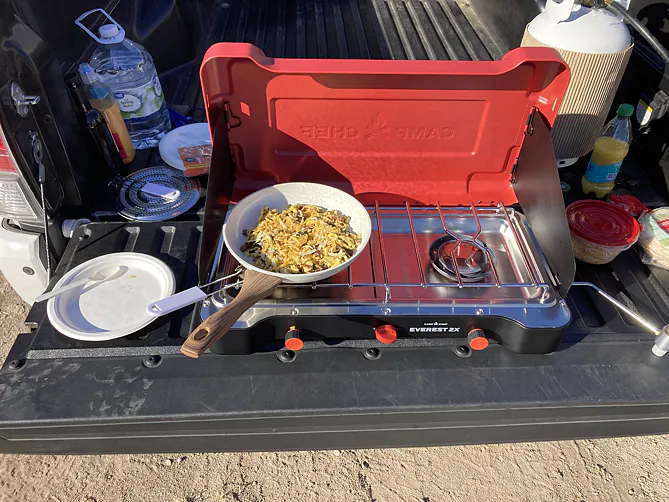
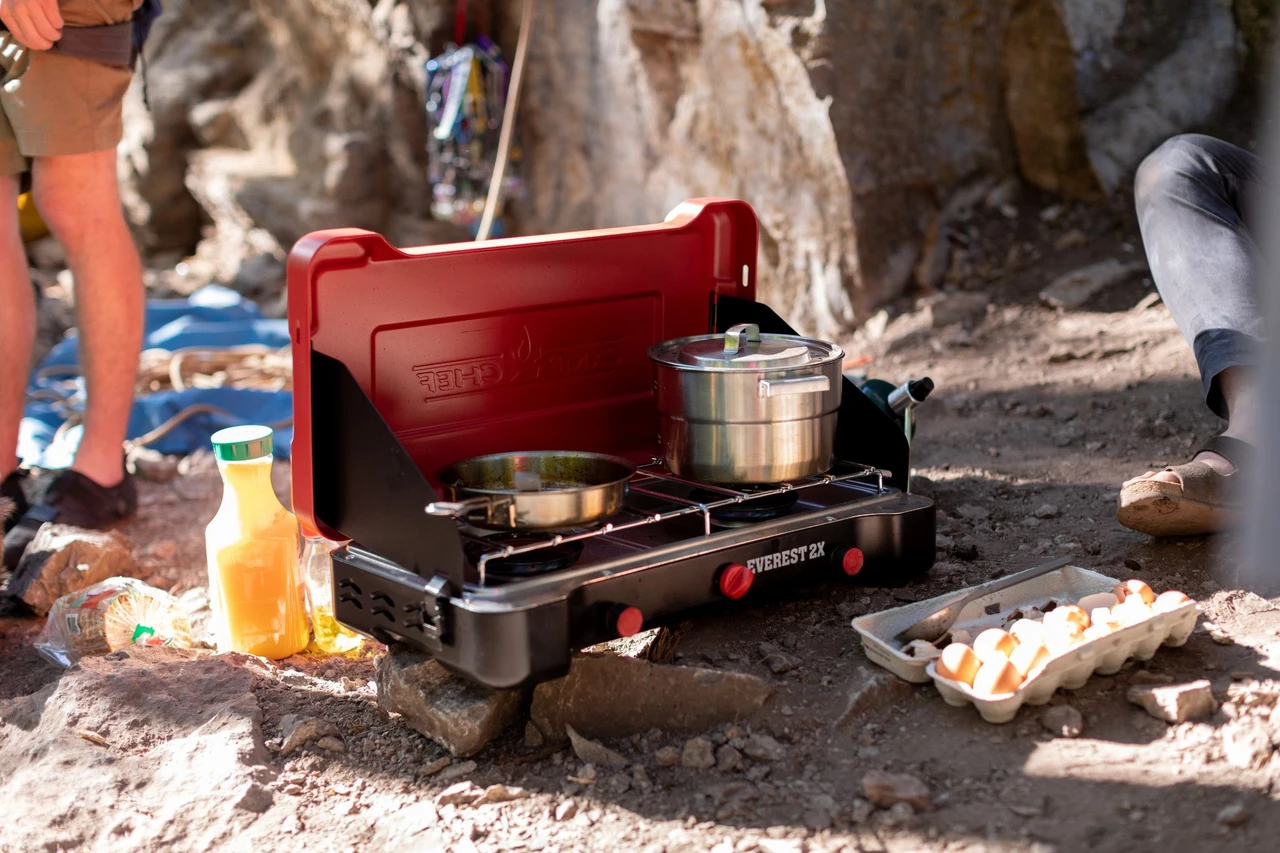
At a vehicle camp, two burners let me cook an actual meal without juggling pots. The Genesis gives each burner four turns of valve adjustment, so I can leave a sauce barely bubbling while a pan heats on the other side. The Everest 2X boils a large pot fast and gets cast iron hot enough to sear, but I have to watch it closely at low heat.
Think about the walk to camp
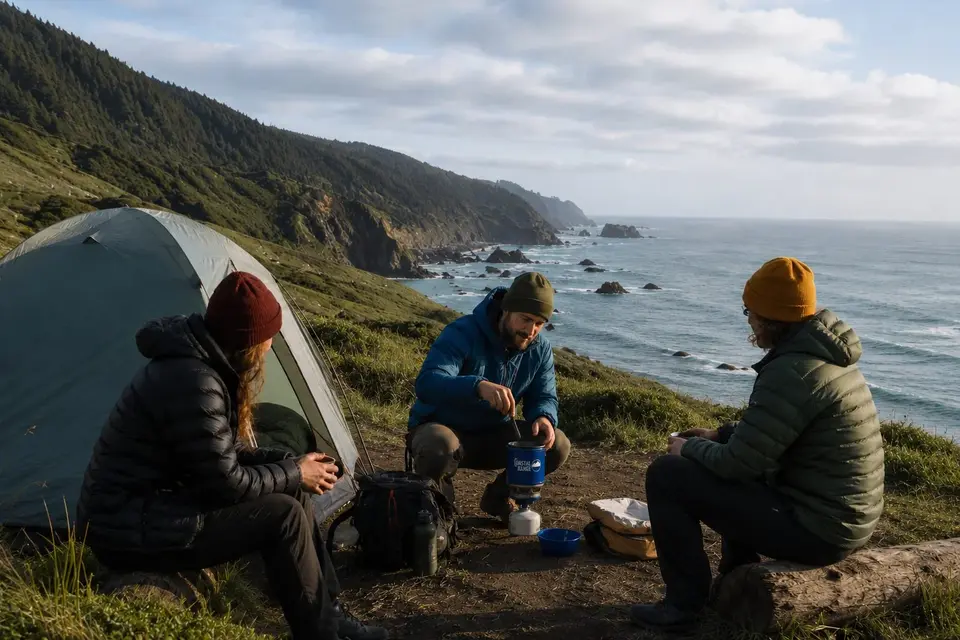
A stove that looks compact in the boot of a car can feel enormous in a rucksack. Coastal Range puts the complete Backpacker system at 260 g before fuel and a pack towel. Jetboil lists the Flash at 371 g, plus a 27 g stabilizer, before you add the fuel canister. Each fits its burner and cup into one tidy bundle. I can pull either one out for a lunch stop without emptying half my bag.
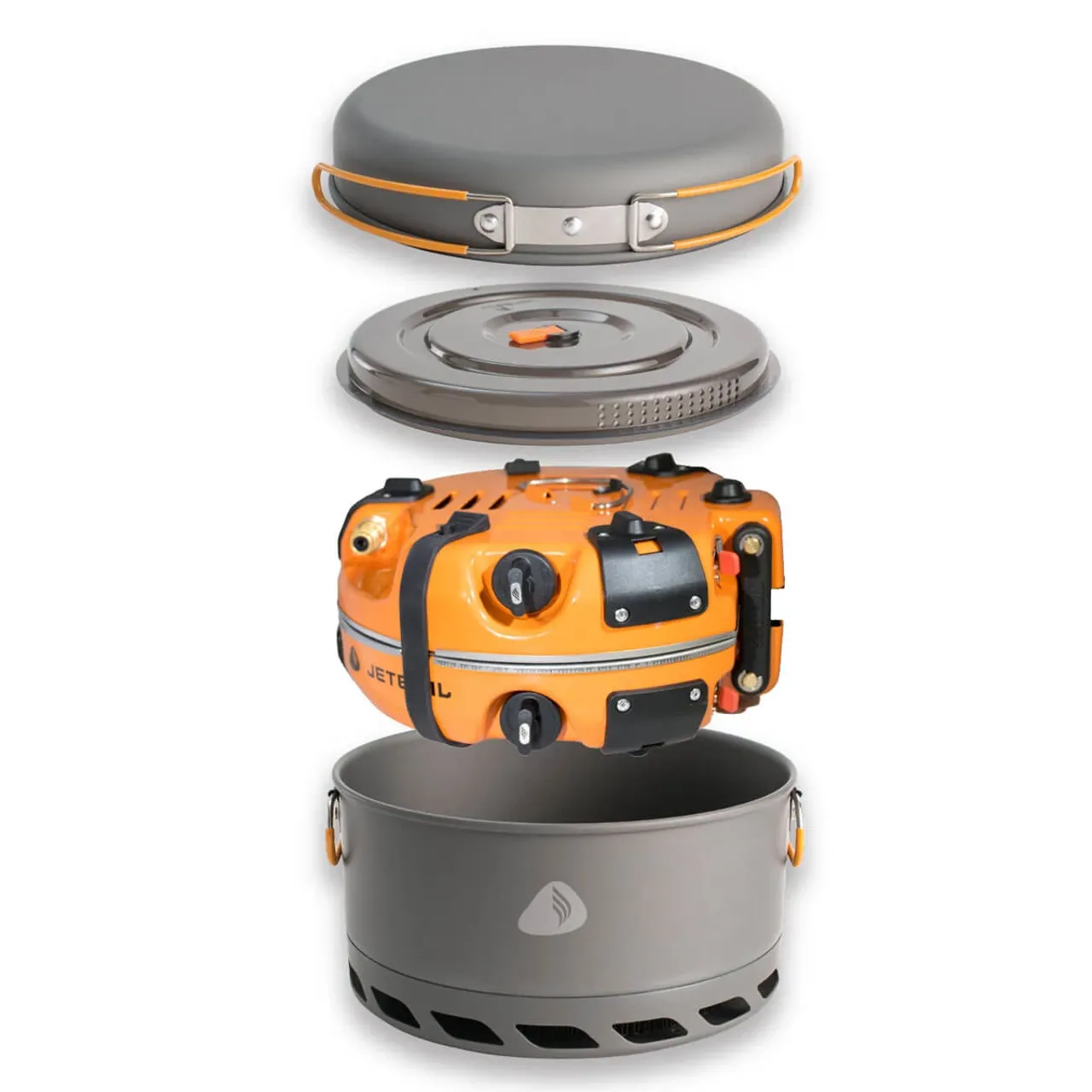
When I call the Genesis compact, I mean compact for a car stove. Its burners fold into the five-litre pot and the frying pan closes the stack. That's clever packing, but the stove, pot and pan weigh 9 lb 1.6 oz before the regulator, windscreen and bag. The Everest weighs roughly 12 lb and folds into a broad steel case. Both are fine for the short walk from the car to a table. I wouldn't fancy carrying either up a hill.
Count everything you need to make dinner: burner, pot or pan, fuel, stabilizer, regulator and a way to light it. A tiny burner loses some of its appeal when you have to pack separate cookware. Equally, a heavier stove with pots that nest together may take up less room in the car than you'd expect.
Match pot size and pan space to the group
Don't read a one-litre pot label and assume you can cook a full litre of food in it. You need room for the water to boil and enough space to stir without slopping dinner over the rim. The Flash's cup works well for one person's drinks and simple meals. The Backpacker's 1.2-litre pot gave me a bit more room when I cooked for four, but I still boiled water in batches.
With a two-burner, check the width as well as the pot size. The Genesis holds its five-litre FluxPot beside the supplied 10-inch pan. I've used that setup to feed eight people, though I planned the menu around the one large pot and two burners. The Everest takes two 10-inch pans or substantial pots on its broad grate. I would still check how their handles sit before buying; two pans can fit on paper and be awkward to move around in practice.
Pay attention to the base too. Both backpacking stoves lock their pots to the burners, but the whole thing balances on a narrow fuel canister. The Backpacker felt top-heavy on uneven rocks and didn't come with stabilizing legs. The Flash's supplied stabilizer helped. The Genesis and Everest sit lower and wider on a table, and I feel happier using a heavy pot on either of them when people are moving around camp.
Check the low flame, then the maximum output
Stove makers love a big BTU number. My Everest has two 20,000 BTU-per-hour burners and brought a litre of water to a strong boil in just over two minutes at camp. That's great when I'm in a hurry. Pancakes and sauces are another story: the low-flame range is so short that a small turn can take it from too hot to out completely.
The Genesis has two 10,000 BTU-per-hour burners and boils a litre in about 3 minutes 15 seconds with its heat-exchanger pot. I'm happy to wait that extra minute because I can leave a sauce gently bubbling without hovering over the knob. The Flash and Backpacker also push plenty of heat into their pots, but thick food takes care. I had to stir oatmeal often in the Backpacker, and the Flash worked best when dinner stayed in its pouch.
I used different pots, water quantities and weather for those boil times, so I wouldn't use them as a league table. If you make rice, eggs or sauces regularly, pay more attention to how easily you can turn the heat down. A fast boil feels less impressive when you're scraping burnt dinner off the bottom of the pan.
Plan for wind and cold mornings
Wind can make a quick-boil stove feel painfully slow. The Flash's shrouded burner coped with light breezes on my trip, but I still hunted for shelter when it blew harder. The Backpacker did fine in light wind; a sustained breeze slowed it down. Don't wrap either upright stove in an improvised windscreen, though. You can trap dangerous heat around the fuel canister.
On my exposed vehicle camps, the Everest's deep lid and attached side panels kept the wind off the burners better than the Genesis's separate screen. The Genesis screen takes more fiddling to fit, and crosswinds still get to the flames. I'd take the Everest to a breezy pitch and save the Genesis for a more sheltered camp where I can enjoy its better simmer control.
Cold caught me out with the Backpacker too. It has no pressure regulator, and its flame weakened near freezing and as the canister ran down. Jetboil publishes a cold-weather operating limit for the Genesis, but I haven't tested mine at that temperature. If you plan to cook through winter, check the fuel and temperature limits for the exact stove and try the whole setup in the cold before relying on it far from help.
Check the fuel you can buy and carry
The Flash and Backpacker use small threaded isobutane-propane canisters. I ran the Genesis and Everest on standard one-pound propane cylinders with their regulators. Check the connection and cylinder size for the exact stove you want; two stoves on the same shop shelf may take different fuel.
Fuel cost starts to bite if you're out for weeks, and availability can be a real nuisance if you're travelling. Think about what you'll do with half-used cylinders too. I buy the right fuel before leaving home and make sure the stove runs with it outdoors. The National Park Service recommends trying a new stove before a trip, which beats finding out at camp that you're missing a regulator or can't get the ignition to work.
Expect the igniter to give up eventually
The built-in igniters failed on three of my four stoves. The Flash's piezo got unreliable during my 90-day trip, both Genesis igniters stopped working fairly early, and the Everest's igniter came loose before it stopped sparking. I could still light all three with a lighter. The Backpacker's ignition worked throughout my one-week test, but a week isn't long enough to tell me how it will age.
That's why I keep a small lighter with every stove. I also check the hinges, latches and regulator hose, plus how much of a pain it will be to clean food out of the burner wells. Heat warped the lid on my Genesis. The Everest's latch and hinges have developed some play, and paint near its burners has scorched. Both still cook dinner, but I pay more attention to those parts now.
Set it up somewhere safe
Find a firm, level place to cook, away from dry vegetation and loose kit. Watch where people walk too; someone catching a pot handle can ruin the meal and cause a nasty burn. A canister-top stove needs extra care because the hot pot sits high above a small base. Check the local fire rules before you light it.
Use fuel stoves outdoors. The National Park Service warns against running camp stoves in tents, vehicles or other enclosed spaces. Rain doesn't make a tent a safe kitchen. Follow your stove's instructions for clearance, fuel connections and wind protection, and turn it off if you smell fuel or suspect a leak.
The stove I would pick for each job
| Your usual trip and meal | What to look for | A stove I've used |
|---|---|---|
| Solo walking, coffee and add-water meals | A compact integrated cup, stable base and quick setup | Jetboil Flash 1.0L. Fast and tidy, with poor simmer control and an igniter that failed in my use. |
| Walking with two or more people who mostly need hot water | More pot capacity without a large weight penalty | Coastal Range The Backpacker. Its 1.2 L pot helped with family batches, but the cozy got too hot to hold after boiling. |
| Vehicle camping with sauces, breakfasts and limited cargo space | Fine flame control, two burners and useful nesting | Jetboil Genesis Basecamp. Easy simmering and compact storage, with weaker wind protection and two failed igniters. |
| Vehicle camping with cast iron, big pots and exposed pitches | High heat, broad supports and built-in wind panels | Camp Chef Everest 2X. Powerful and steady, though its low flame is touchy and the case takes space. |
These four stoves cover a lot of the cooking I do, but you may need something else. A liquid-fuel stove or a small burner with a separate pot could make more sense for your trip. I would still start with the meals and the walk to camp, then check the cookware fit, fuel, stability and flame control of the stove you're considering.
Stoves I've used
Read the full reviews
For a closer look at the two vehicle stoves, read my Genesis vs Everest 2X comparison. You can also browse all our cooking gear reviews.
Sources
Where the figures come from
I used the Flash for 90 days, the Backpacker for a week and the Genesis and Everest for about three years each, on separate trips. The full reviews give the conditions and the manufacturer specifications I checked. For the campsite safety advice, I used the National Park Service's stove guidance and its camp cooking advice.
Editorial disclosure: Adam bought all four stoves with his own money. None of the manufacturers supplied equipment, funding or editorial input for the linked reviews or this guide.