
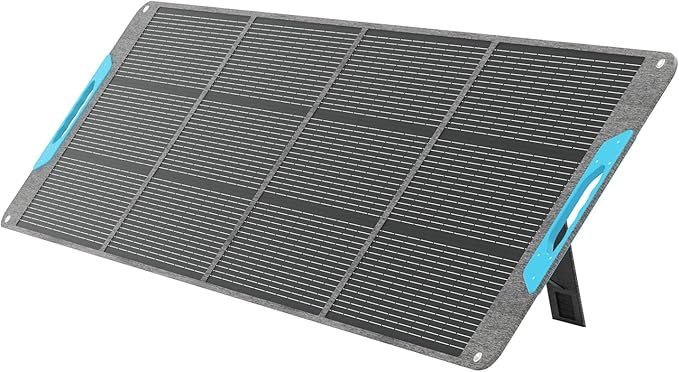
What works
- Regularly produces 160-170W in strong sun, with a measured 177W peak
- Unfolds, stands and connects in roughly 35 seconds
- Four-fold package is easy to carry one-handed and stow aboard
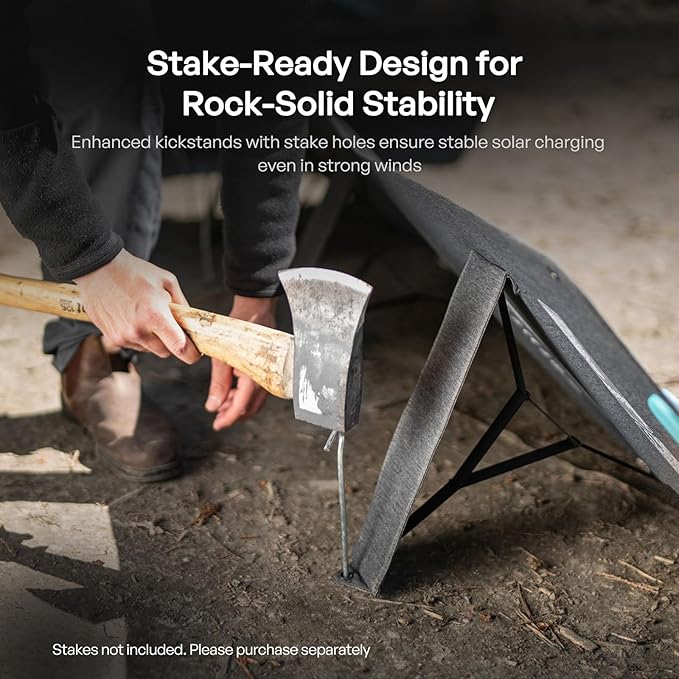
- Stake-ready kickstands are sturdier than those on budget panels
- Standard solar connectors plus direct USB charging add flexibility
- Excellent performance and build for the $219 purchase price
What to know
- About 14 lb, making it a basecamp panel rather than backpacking gear
- Kickstand angle is not easy to fine-tune
- Small shadows across one section noticeably cut total output
- Hot panels and heavy cloud reduce generation significantly
- IP65 means splash-resistant, not submersible or storm-proof
- An extension cable is useful but not included
The verdict
The Renogy E.Flex 200W gets the central promise of portable solar right: it produces enough useful power to justify carrying and deploying it. In clear, cool conditions I saw 177W through a Victron MPPT controller. Strong sun more often delivered 160-170W. That is close enough to the 200W laboratory rating to feel honest, and substantially better than the inflated claims and unstable stands I have encountered on cheaper folding panels.
For a month of camping across Quebec, it was our only source of electricity. With a 12V LiFePO4 battery, USB outputs and a small inverter, it kept Starlink, a laptop, phones, flashlights and other daily electronics working when the sun cooperated. It then spent a full spring and summer cruising season of about seven months as a backup panel in the Mediterranean.
Its limits are equally practical. Nearly 14 lb is portable from a car to camp or a locker to the deck, not over hiking miles. It needs regular repositioning, its kickstands are awkward to fine-tune and a mast, boom, halyard or tree shadow can erase a surprising amount of output. IP65 protection is useful around damp camps and occasional spray, but this is not a panel to abandon in a downpour or leave exposed offshore. As deployable basecamp, RV or at-anchor power, however, it is difficult to fault for the price.
How I tested the Renogy 200W
The first sustained test was roughly a month of camping around Quebec, including the Laurentides, the Mont-Tremblant area and Saguenay National Park. The panel was the only source feeding our battery system, so its job was not a token phone top-up. It had to cover remote work and normal camp life through hot sun, forest shade, overcast days and periods of torrential rain.
I then carried it aboard a cruising catamaran for a Mediterranean spring and summer season of about seven months. It served as a deployable backup to the boat’s permanent charging system, usually on the trampoline or a clear patch of deck while at anchor. That exposed the panel to wind, heat, moving shadows, occasional spray and the constant storage constraints of a liveaboard boat.
Output figures came from the connected Victron MPPT controller. The panel charged a 12V LiFePO4 battery system that supplied USB devices and a small inverter. I also used the panel’s own USB output for direct charging.
Setup, connections and angle adjustment
From packed to generating takes about 35 seconds. Unfold the four sections, release the legs, position the panel and connect the standard solar plugs. The leg snaps and magnetic carry-handle closure make the physical process unusually smooth, and someone unfamiliar with portable solar should understand it immediately.
The connectors fed a Victron MPPT controller and then the 12V LiFePO4 battery. A controller is essential when charging a bare battery; the panel should not be wired directly to one. For compatible power stations, connection can be close to plug-and-play as long as the input voltage and connector arrangement match. The integrated USB outputs are useful when a phone or small device needs power without involving the full battery system.
The kickstands are sturdy but not elegant to adjust. They do a good job holding the long array at a useful low-sun angle, yet precise tuning takes more wrestling than it should. That becomes irritating because repositioning the panel during the day is absolutely worthwhile. Good alignment pushed the controller past 150W; a lazy angle left meaningful energy on the table.
Portability and storage
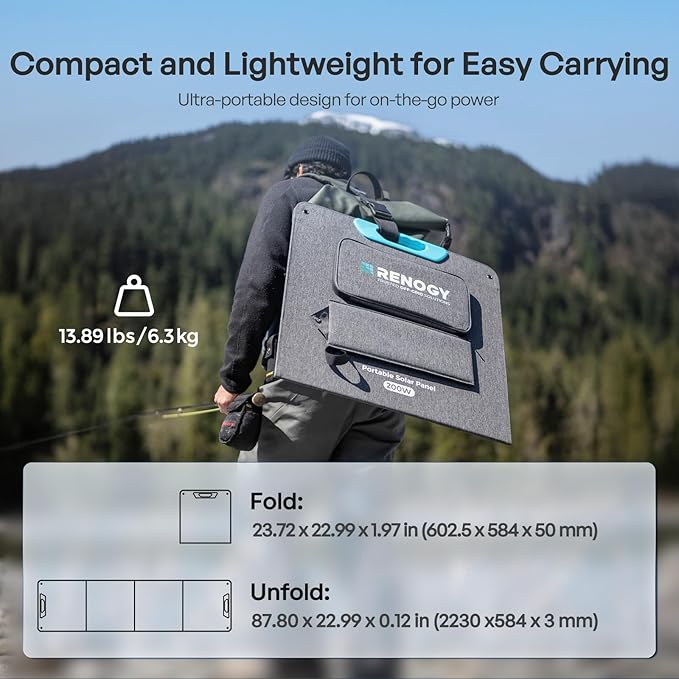
Officially, the 200W model weighs 13.89 lb (6.3 kg). That is easy enough to carry one-handed for the short trip from a vehicle to a campsite or from a boat locker to the deck. The integrated handle is comfortable and the magnetic closure prevents the panel flapping open in transit.
Folded, it measures about 23.7 by 23 by 2 inches. The square shape slid into a locker, stood flat against a bulkhead and fitted beneath a berth far more neatly than a large rigid panel. The attached zippered compartment also kept connectors and adapters together and protected them from being crushed.
Calling it portable still needs context. I would not carry it far down a trail with normal camping equipment. It is ideal for basecamp, car camping, RV use and boats; backpackers should look for a lighter and less powerful solution.
Real-world output, cloud and shade
The best observed result was about 177W on a clear, cool day. With direct sun, a clean surface and a sensible angle, 160-170W was normal. Portable panels rarely reproduce their laboratory rating once cell temperature, cabling, controller losses and real weather enter the picture, so that performance exceeded my expectations.
Heat has a visible cost. As the black surface bakes through the afternoon, output flattens even if the sky remains clear. Heavy cloud is a much bigger problem: near Mont-Tremblant, prolonged overcast reduced generation to a trickle and forced us to prioritise essential loads.
Partial shade is the most frustrating weakness. A branch at camp or a moving halyard on the boat can cross only part of the four-section array and still cause a disproportionate drop at the controller. Anyone expecting full output beneath trees or among sailing rigging will be disappointed. Open exposure and frequent repositioning are the route to the panel’s best numbers.
A month as the only camping power source
In Quebec, the panel earned its rating by doing ordinary work day after day. A 200W input and 12V LiFePO4 storage were enough to keep Starlink, a laptop and small electronics available for remote work, while also covering phones, lights and routine charging. With decent sun, daily production kept pace with our consumption through consecutive off-grid days.
Dense forest made site selection more important than the panel itself. I often had to move it as patches of sun shifted across camp. The 35-second setup made that tolerable, and the stable legs were noticeably better than bargain panels that blow over or collapse on rough ground.
The stake holes are useful when wind rises, although stakes are not included. I generally left the panel deployed in settled conditions and secured the legs if gusts developed. Trips included torrential rain, but I packed the panel away for the worst of it rather than treating an IP65 electrical product as fully waterproof.
Seven months as a cruising backup
On the catamaran, the panel made most sense at anchor. The trampoline or a clear section of deck offered enough area to unfold it, and I always tied it down so a gust could not put it overboard. Underway, a wide folding panel and loose charging leads are harder to manage, and permanent rigid panels remain the better answer for primary marine generation.
Rigging shadows were relentless. As the boat moved, the mast, boom and halyards swept across the cells and pulled output down. Cable routing also needed care to keep the deck safe, particularly around a two-year-old. An MC4 extension lead was useful for keeping the controller and battery system sheltered while the panel found the clearest sun.
It handled occasional mist and deck spray without an electrical fault, but I kept it away from sustained salt water and rinsed connectors and hardware with fresh water after exposure. I would trust it as at-anchor backup power on a longer cruise, not as a panel to leave deployed through serious offshore conditions.
Durability, weather resistance and cleaning
After the season, the folding structure, snaps, magnetic closures, handle and connectors remained solid. The cell surface stayed clear without cracking, clouding or obvious deformation. Storing the leads in the attached pouch prevented the common problem of connectors being crushed under other gear.
Renogy rates the panel IP65: dust-tight and resistant to water jets, but not intended for submersion. That is adequate for normal outdoor use if treated intelligently. It survived mist, light rain and spray, but I would still bring it in during a prolonged downpour and would never leave its connector area sitting in water.
Cleaning matters. Dried salt spray, pollen or campsite dirt visibly reduced production by roughly 10-15%. A damp microfibre cloth restored the surface quickly, and the dark cells dried almost immediately once back in sun. I saw no meaningful loss of reliability or maximum output over the test period.
Everyday usability and safety
The supplied leads are adequate when the battery or power station can sit nearby, but an MC4 extension cable makes a much better installation. It lets the energy-storage equipment remain in shade and out of weather while the panel moves to the sun. I would rather Renogy included one.
The standard connectors are secure and polarity is difficult to confuse, although releasing their locking tabs takes some finger strength. The panel itself becomes extremely hot in summer sun, as expected, but I saw no structural concern. Charging interruptions came from passing people, branches or rigging shadows rather than faults in the panel.
Direct USB charging is the simplest use. Charging a LiFePO4 battery requires a correctly specified controller and safe wiring. In my setup, the Victron MPPT was a crucial part of reaching strong output and protecting the battery; the panel alone is only one component of that system.
Who should buy it
The Renogy suits car campers, basecamp users, RV owners and liveaboards who want substantial deployable power without committing deck, roof or vehicle space to another permanent panel. It is especially compelling when a compact stored shape and quick deployment matter more than minimum weight.
Backpackers should avoid it, as should anyone needing a panel that can stay outside through submersion, heavy continuous rain or serious offshore weather. Boat owners seeking primary generation should install rigid panels; this folding Renogy is better as flexible backup at anchor.
At $219, it undercut the comparable EcoFlow and BLUETTI options I considered while producing excellent real-world output. I would buy it again. Two smaller panels would create more wiring and setup on a busy deck, while this single four-section unit balances storage, stability and useful power exceptionally well.
Renogy 200W test details
| Tested model | Renogy E.Flex 200W N-Type Portable Solar Panel, RPP200EF-SE-G2-US |
|---|---|
| Rated power | 200W at standard test conditions |
| Highest measured output | About 177W |
| Typical strong-sun output | About 160-170W when clean and properly angled |
| Rated voltage and current | 18.8V at maximum power; 10.6A |
| Open-circuit voltage | 21.6V |
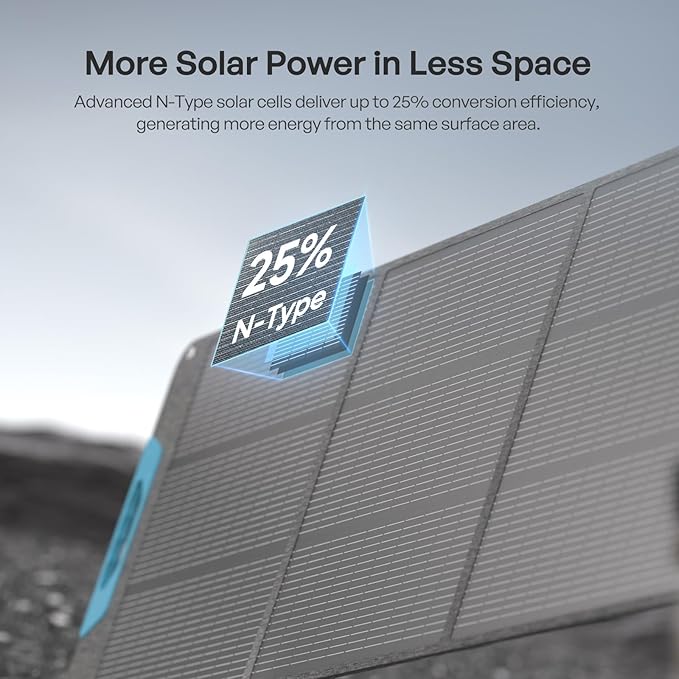
| Cell efficiency | Greater than 25%, manufacturer figure |
| Weight | 13.89 lb / 6.3 kg |
| Folded dimensions | 23.72 × 22.99 × 1.97 in / 602.5 × 584 × 50 mm |
| Unfolded dimensions | 87.80 × 22.99 × 0.12 in / 2230 × 584 × 3 mm |
| Water resistance | IP65, splash-resistant and dust-resistant; not submersible |
| Primary test system | 12V LiFePO4 battery, Victron MPPT controller, USB loads and small inverter |
| Price paid | $219 |
| Test period | One month as sole camping power; about seven months as Mediterranean cruising backup |
| Manufacturer involvement | None. No free sample, support, sponsorship or copy approval. |
Scoring breakdown

Sources & context
What we checked
This review is grounded in Adam’s month of off-grid camping in Quebec and seven-month Mediterranean cruising season. Setup, output, shade sensitivity, storage, weather and durability observations come from that use. Electrical and dimensional specifications were checked against Renogy’s product information; the tested version was purchased through the original retail listing.
Editorial disclosure: Adam bought this Renogy 200W portable solar panel with his own money for $219. Renogy did not know it was being reviewed and provided no payment, free product, support, trip assistance or editorial approval.