
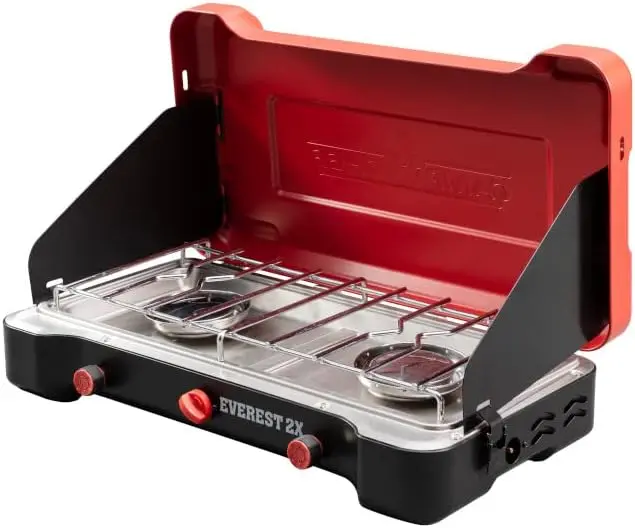
I bought the Camp Chef Everest 2X from Amazon for $194.18 and have owned it for about three years. Camp Chef supplied no product, funding or support and had no involvement in this review. I have used the stove on eight or nine vehicle-supported camping trips, cooking with large pans, heavy pots and cast iron in cold, wind and at altitude.
Quick verdict
The Everest 2X earns 4.1 out of 5. Its two 20,000 BTU burners boil a litre of water in just over two minutes, run at full power together and remain dependable in moderate wind behind the deep lid and side panels. The broad steel frame feels secure under heavy cookware and setup takes less than 30 seconds. Low-flame control is much weaker: the narrow adjustment window makes pancakes, rice and sauces unnecessarily demanding. My piezo igniter failed early, the latch and hinges have loosened, and paint around the burner wells has started to flake. It remains a very good high-output stove for car camping, but it is neither delicate nor compact.
What works
- Two 20,000 BTU burners deliver serious heat
- Both burners hold full output simultaneously
- One litre boils in just over two minutes
- Deep lid and side panels block moderate gusts
- Wide steel frame is stable with heavy cookware
- Cast iron and high-heat cooking suit it perfectly
What to know
- Low-flame adjustment is touchy and easy to extinguish
- Piezo igniter became loose and stopped sparking
- Central hot spots punish thin cookware
- Roughly 12-pound body is bulky in a vehicle
- Latch and hinges have developed some play
- Paint near the burners has scorched and flaked
The verdict
The Everest 2X is a powerful camp stove with a clear preference for fast boiling, searing and large cookware. Open both valves and it behaves like a compact industrial burner: water reaches a hard boil quickly, cast iron heats with authority and a second pan can run at the same time without an obvious pressure drop.
Fine cooking exposes its main limitation. The usable gap between too much heat and a flame that goes out is narrow. Pancakes demand close attention, bacon needs frequent movement and rice or sauces are easier in thick cookware that can buffer the concentrated heat. The stove can cook these foods, but the control knobs never feel as cooperative as the burners are powerful.
After three years, I still consider it worth the $194.18 I paid and would buy it again. The failed igniter and cosmetic deterioration prevent an elite score, while the solid core performance keeps it comfortably above average. Buyers who camp by vehicle and cook hot, substantial meals are the right audience.
How I tested the Everest 2X
My stove has been on about eight or nine camping trips over three years. It travelled in a vehicle, then worked from tailgates, picnic tables and uneven camp tables. The range of use included moderate wind, cold weather and high-altitude cooking, with enough repeated packing to expose wear in the latch, hinges and finish.
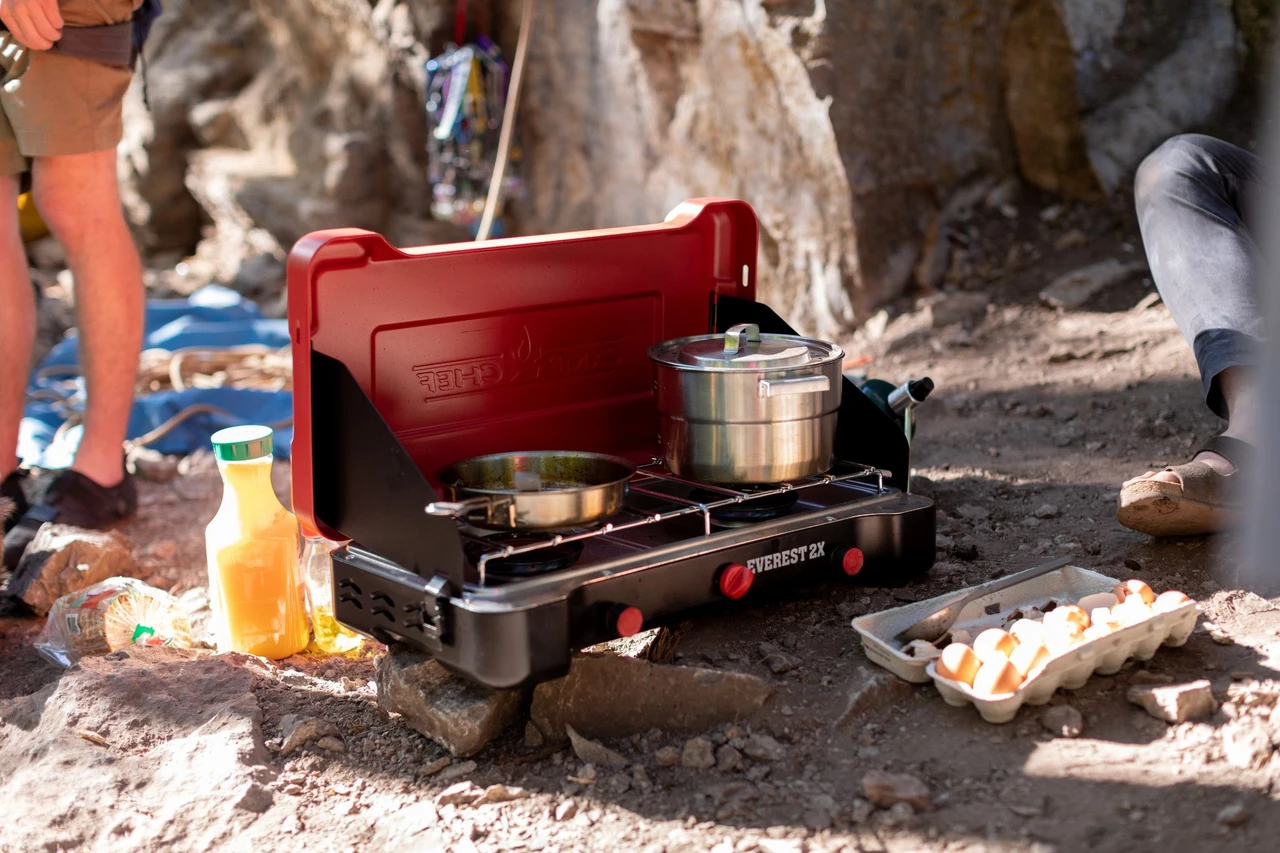
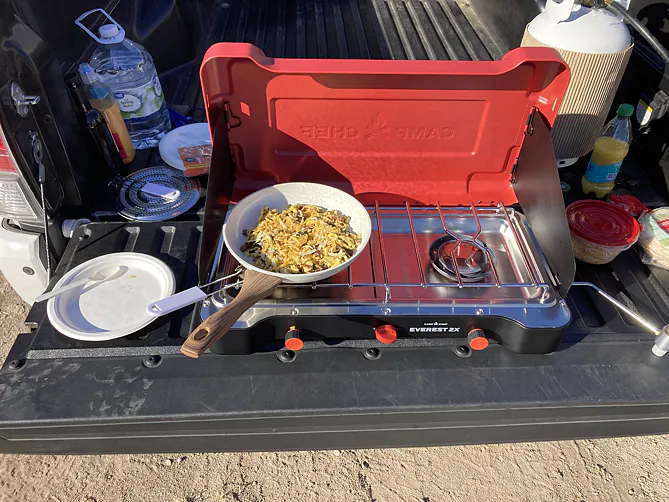
I used standard one-pound propane cylinders and ordinary camp cookware rather than a proprietary pan system. Two 10-inch pans fit side by side, although the arrangement becomes cosy once both handles and cooking utensils enter the picture. Heavy pots and cast iron sit confidently on the nickel-coated steel grate.
The stove was assessed through real meals rather than a string of laboratory boils. Pancakes, bacon, rice, sauces, frying and large pots each reveal a different part of the performance envelope. Thin cookware highlights the central hot spot; cast iron makes better use of the available output.
Boiling speed and burner power
Camp Chef rates each burner at 20,000 BTU per hour, giving the stove 40,000 BTU per hour in total. Both burners can operate wide open without a noticeable pressure drop. That capacity is useful when one side is boiling a large pot and the other is heating a frying pan.
In representative camp conditions, I can bring one litre of water to a strong boil in just over two minutes. Wind, temperature, pot shape and starting water temperature naturally change the timing, but the Everest is consistently fast. Waiting for heat has never been a frustration.
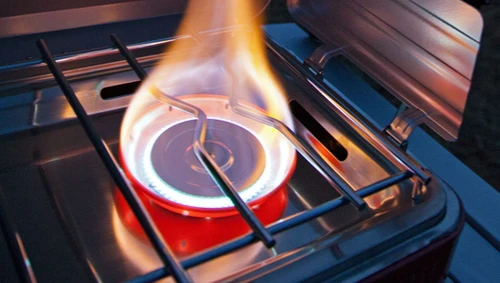
The circular burners send a concentrated band of energy into the centre of the pan. With a thin aluminium pan, food in the middle browns before food near the edge. Heavy cast iron takes longer to preheat, then spreads that power more evenly and holds enough energy for confident searing.
Simmer control and everyday cooking
The stove's weakest cooking trait is its low end. Small movements of the control knob create disproportionately large changes in the flame. Turn down a fraction too far and the burner can go out, especially when a gust finds its way around the wind panels.
Delicate meals therefore require more intervention than they should. I move pancakes around the pan, stir sauces frequently and watch rice closely. A heat diffuser or heavy-bottomed pan helps, but neither fixes the underlying valve response.
Medium and high settings are far easier to manage. Frying, boiling and reheating large quantities play to the stove's strengths. Camp cooks who mainly use cast iron, kettles and substantial pots will encounter the control weakness less often than cooks who want to hold a barely visible flame.
Wind, ignition and cold-weather use
The attached lid and deep side panels provide excellent shelter. Moderate gusts have little effect on the flame, and I usually notice a meaningful loss of performance only around 15 to 20 mph. The panels clip into place quickly and do not add a separate piece of equipment to the packing list.
The piezoelectric igniter was reliable when new, then became finicky, rattled loose and eventually stopped sparking. I now light the burners with a stormproof lighter. The stove remains fully usable, but a built-in igniter should survive more than a handful of trips.
Once lit, it has performed well in cold weather and at altitude on standard one-pound propane cylinders. I still carry a lighter regardless of season; piezo systems are convenient, not a substitute for a basic ignition backup.
Cook space and stability
Camp Chef lists 215 square inches of cooking area. Two 10-inch pans or substantial pots fit together, though the handles need deliberate positioning. The grate supports cookware across a broad area rather than balancing it over a narrow burner ring.
The stove remains planted on tailgates and camp tables, even with liquid-filled pots. Large knobs can be used in gloves, and the side panels shield the cooking area without making access awkward. This is a reassuring platform when several people are moving around a busy camp kitchen.
Its stability depends on the table beneath it. The steel case cannot correct a soft or badly sloped surface, and its own weight makes a flimsy table less suitable. On firm ground or a secure worktop, the footprint feels solid.
Setup, fuel and portability
Setup takes less than 30 seconds. Release the side latch, open the lid, lock the two wind panels into position and connect the regulator hose. Nothing needs assembly, and the controls are immediately visible.
The regulator has not leaked or produced a noticeable pressure drop. Mine makes a faint whistle under heavy demand, so I monitor it rather than presenting online reports of regulator trouble as something that happened during this test. Any smell of propane or suspected leak would be a reason to shut the stove down rather than continue cooking.
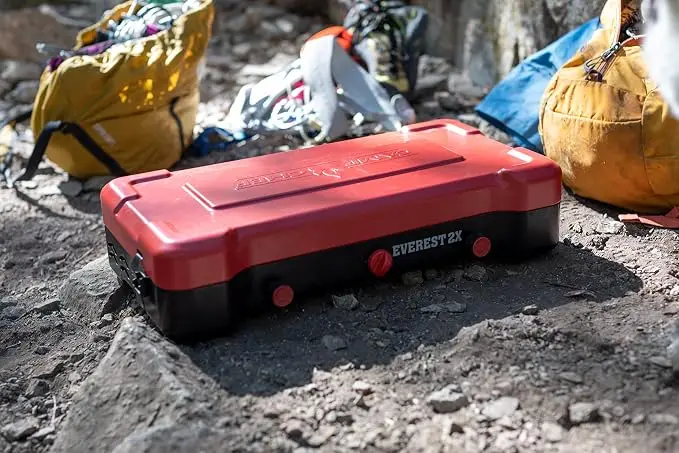
At roughly 12 pounds, the Everest is vehicle equipment. The closed case is straightforward to lift from a boot to a picnic table, but it occupies a broad rectangular space and has none of the Jetboil Genesis system's nesting efficiency. I would not carry it any meaningful distance under my own power.
Cleaning and durability
The removable grate lifts away easily and exposes most of the stainless cooking surface. A cloth handles fresh spills quickly. Grease, crumbs and boil-overs become more stubborn once they enter the tight gaps around the burner wells and hinge joints, so cleaning before transport saves work later.
The main structure still feels strong, but three wear points are visible. The wire latch has bent slightly out of alignment. The sheet-metal hinges have gained a little side-to-side play after riding in the vehicle. Neither issue currently stops the case from closing or the lid from standing correctly.
Heat has discoloured the finish around the burners, and the powder coating has started to scorch and flake. Damp storage can then leave small surface spots on the exposed metal. These are not yet structural problems, although eight or nine trips is not a severe enough workload to excuse every sign of deterioration.
The dead igniter is the most consequential failure. It does not prevent the burners from operating, but it removes a feature sold as part of the stove and forces a workaround on every trip.
Camp Chef Everest 2X vs Jetboil Genesis and Coleman Triton
The Jetboil Genesis Basecamp takes a different approach. Its burners offer much better low-flame control, and the clamshell stove nests inside its own pot for remarkably efficient packing. The Everest responds with twice the rated output per burner, stronger integrated wind protection and greater enthusiasm for heavy cast iron. Choose the Genesis for compact storage and careful cooking; choose the Everest for raw heat and exposed camps.
A conventional Coleman Triton is a simpler value proposition. It is generally lighter and less expensive, with enough performance for ordinary camping meals. The Everest feels more rigid and produces far more heat. Frequent group cooks and cast-iron users will notice the upgrade, while occasional campers may not need to carry or pay for it.
Separate backpacking burners weigh far less and divide neatly between packs. They also create tall, narrow cooking platforms that are poorly suited to large pans or a busy vehicle camp. The Everest belongs in a different category: it prioritises a stable work surface and high total output over carried weight.
Price and value
I paid $194.18 three years ago. At that price, the Everest 2X has delivered strong value. It heats faster and handles wind better than many ordinary suitcase stoves, supports full-size cookware and still runs both burners properly after repeated transport.
The igniter failure is difficult to overlook because it happened early. Latch movement, hinge play and flaking around the burner wells also reduce confidence in the details, even though the burner system and grate remain dependable.
A 4.1 score reflects that split. The Everest is excellent at its central job and compromised around the edges. It earns a recommendation for high-output vehicle camping, not a blanket endorsement for every style of outdoor cooking.
Who should buy it
Buy the Everest 2X for car camping, overlanding, tailgating and group basecamps where fast boiling, strong wind protection and support for heavy cookware take priority. It is particularly well suited to cast iron, big breakfasts and meals that use two hot burners together.
Avoid it for backpacking, space-constrained vehicles or cooking built around delicate low-temperature control. Campers who mostly make coffee and simple one-pot meals can spend less and carry less.
I would buy it again. I would also pack a lighter from day one, use heavier cookware when possible, clean spills before they reach the hinges and leave enough dry storage space for a 12-pound steel case.
Camp Chef Everest 2X specifications
| Tested model | Camp Chef Everest 2X, SKU MSHPX |
|---|---|
| Burners | 2 |
| Output | 20,000 BTU/h per burner; 40,000 BTU/h total |
| Published cook area | 215 sq in |
| Ignition | Push-button matchless ignition; failed during testing |
| Fuel used | Standard 1 lb propane cylinders through the supplied regulator |
| Approximate carried weight | About 12 lb / 5.4 kg |
| Observed boil time | Just over 2 minutes for 1 litre in representative camp conditions |
| Cookware tested | Two 10-inch pans, heavy pots and cast iron |
| Price paid | $194.18 USD from Amazon |
| Test period | About 3 years across 8-9 camping trips |
| Brand involvement | None. No product, funding, support or copy approval. |
Scoring breakdown

Sources & context
What we checked
This review is grounded in Adam's three years and eight or nine trips with his own stove. The burner output, total cooking area, model identifier and fuel-system compatibility were checked against Camp Chef's current product information.
Editorial disclosure: Adam bought the Everest 2X with his own money for $194.18. Gear Reviews received no payment, free product, support or editorial approval from Camp Chef.