
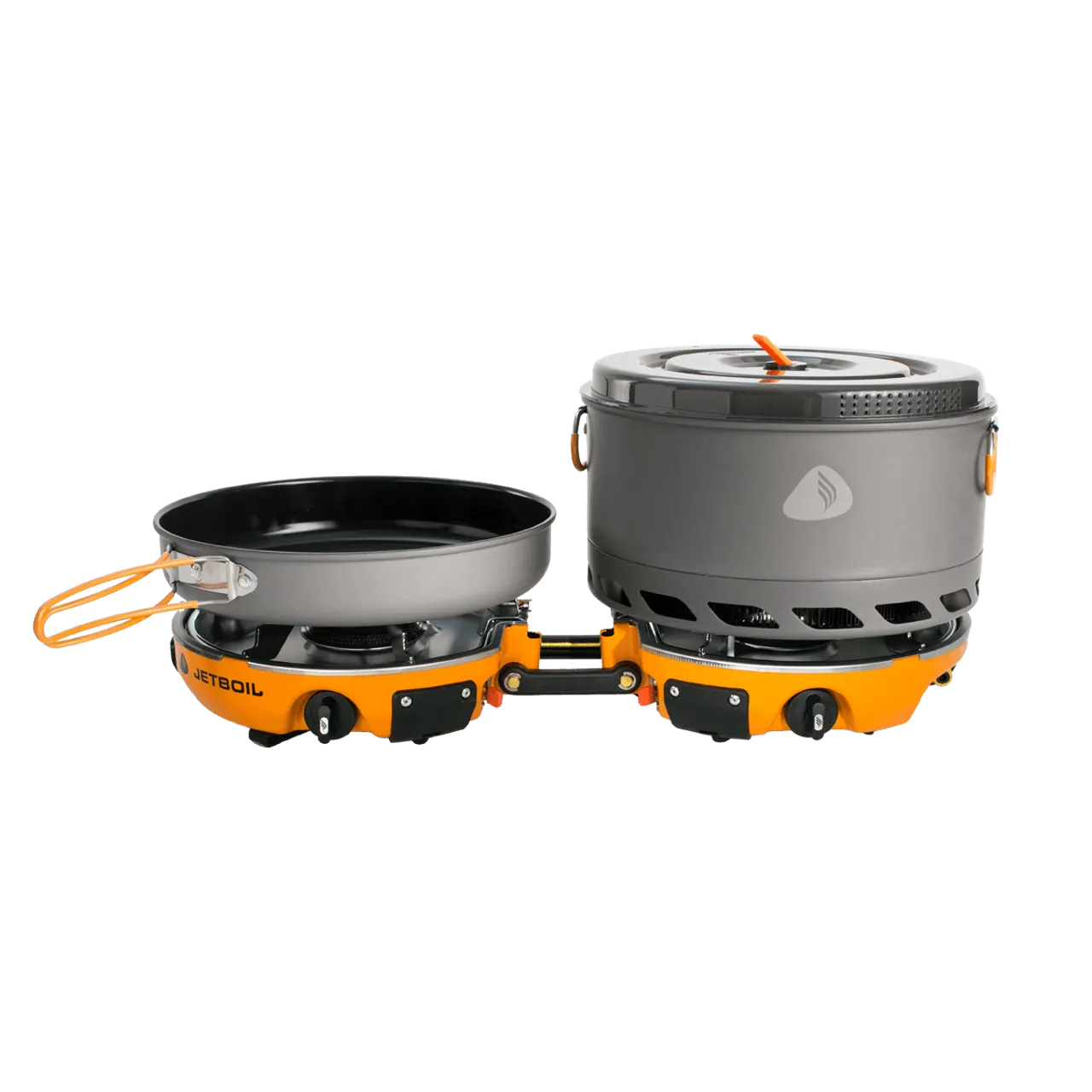
I bought the complete Jetboil Genesis Basecamp System from Amazon.com for $337.49 and have used it for about three years. Jetboil did not provide the system, fund the testing, offer support or know the review was taking place. It has cooked on countless camping trips across Europe and Canada, at festivals, and on Mediterranean beaches while sailing. I take it when travelling by vehicle or operating from a reliable basecamp. At 9.1 pounds before some accessories, it is far too bulky for ordinary backpacking.
Quick verdict
The Genesis earns 4.4 out of 5 because its two compact burners cook more like a controlled camp kitchen than a crude portable stove. Four turns of valve adjustment make low simmering easy, the five-litre FluxPot boils quickly and the nested package saves a surprising amount of vehicle space. The low, wide frame remains steady with large pans and has fed groups as large as eight. Wind exposes the burners' limits, both of my integrated igniters failed early, grease is awkward to clean from the burner wells and my plastic pot lid warped. Those faults matter on a $337.49 system, but none has stopped the core stove from working after three busy years.
What works
- Four-turn valves provide excellent simmer control
- Two burners hold full output together
- FluxPot boils one litre in about 3 minutes 15 seconds
- Five-litre pot and 10-inch pan work side by side
- Low, broad frame is stable with heavy cookware
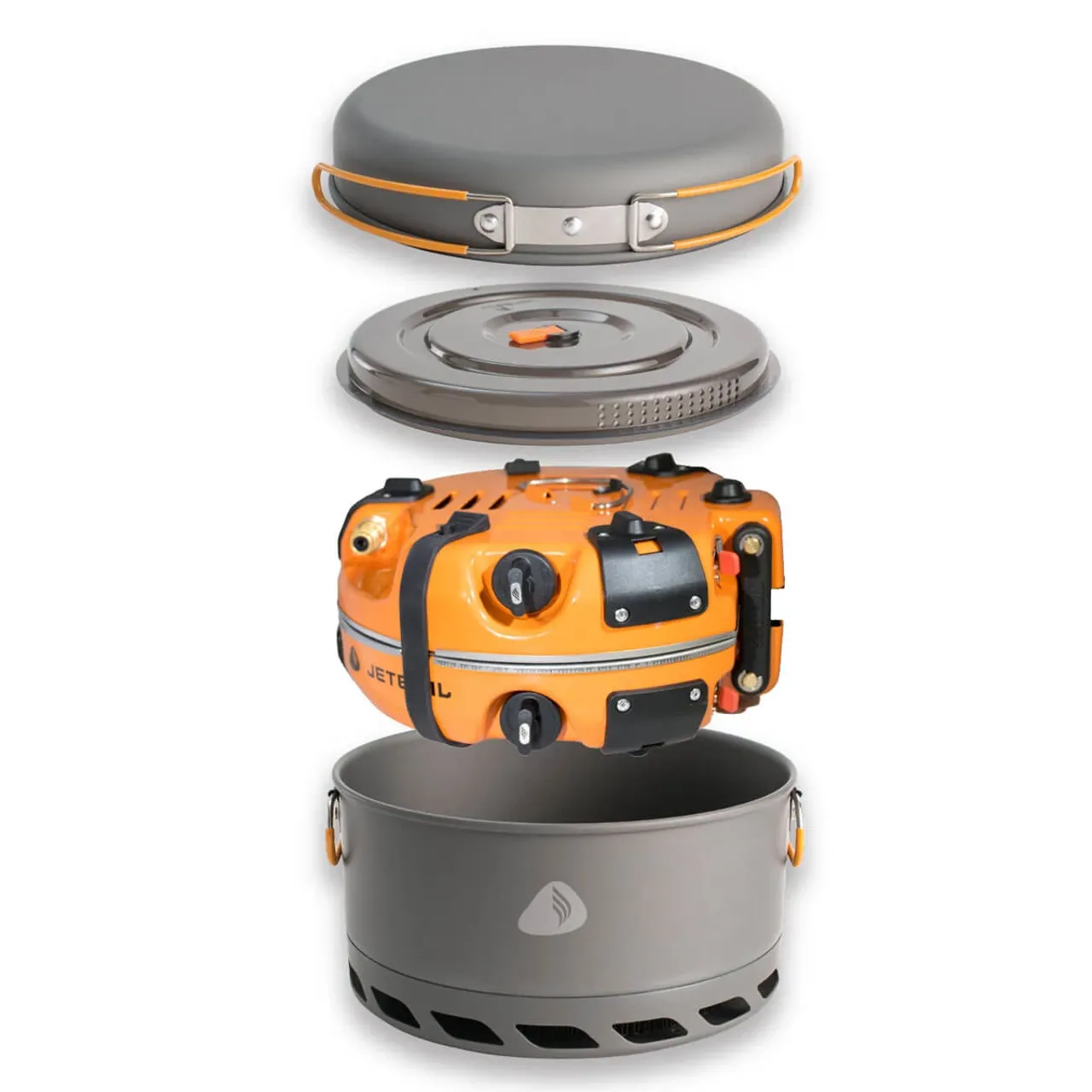
- Whole stove nests into the pot and padded bag
What to know
- Both integrated igniters failed fairly early
- Exposed burners lose performance in strong wind
- Windscreen clips are fiddly
- Grease collects in hard-to-reach burner wells
- The plastic lid on my system warped
- High purchase price and unsuitable for backpacking
The verdict
The Genesis Basecamp is for people who want to cook at camp rather than merely boil water. Plenty of two-burner stoves can blast a kettle, yet many become difficult when bacon needs crisping slowly, a sauce needs holding below a boil or breakfast needs two pans running at different temperatures. The Genesis gives each burner a long, usable control range and holds a low flame without repeatedly dropping out.
Its other trick is packaging. A conventional suitcase stove occupies a wide rectangle in the vehicle whether it is open or closed. The Genesis folds into a clamshell, sits inside its five-litre pot and uses the frying pan as the top of the stack. The bag is still substantial, but the compact cylinder is easier to fit among food boxes, sailing equipment and festival kit.
The faults are annoyingly predictable. Push-button ignition was convenient only while it lasted, and both igniters stopped working fairly early in my ownership. A lighter makes that failure easy to work around, but an expensive stove should not lose both built-in igniters so soon. Wind protection is also less complete than the neat form suggests. Add a warped plastic lid and the 4.4 score feels earned rather than generous.
How I tested the Genesis
This system has been used for about three years on more trips than I can sensibly count. It has travelled across Europe and Canada, served at festivals and cooked on beaches during Mediterranean sailing. Those settings brought cold mornings, rain, damp air, summer heat, salt-laden coastal conditions and enough wind to show exactly where the exposed burner design struggles.
Most use has been vehicle-supported or based around a fixed camp, the environment where the Genesis works best. I have used the complete system with both burners, the five-litre FluxPot, 10-inch ceramic-coated frying pan, windscreen, regulator and carry bag. The largest group I cooked for was eight. That exceeds Jetboil's listed group size of three to five, but the capacity was manageable when meals were planned around the large pot and two simultaneous burners.
Testing focused on real meals: breakfasts, sauces, pasta, hot drinks, pan cooking and group quantities. I also used ordinary kettles, stainless-steel pots and heavy cast-iron pans because the Genesis is sold as an open cooking platform rather than a pot-specific boiler.
Ignition and cold-weather use
The lever igniters worked cleanly at first. Press, spark and cook. Both stopped working fairly early, turning the built-in ignition from a feature into dead hardware. Cold, damp and windy conditions were especially good at revealing the weakness before the igniters failed completely.
The burners themselves continue to light and run with an external flame. I keep a stormproof lighter in the carry bag and would tell every Genesis owner to do the same from the first trip. Matches provide a second backup. This makes the fault inconvenient rather than trip-ending, but that distinction does not excuse it.
Jetboil specifies regulated performance down to 20°F, or -6°C. My use covered cold starts and early-season weather without pressure surging. I did not conduct a laboratory low-temperature test, so the published threshold belongs in the specifications rather than being presented as my measurement.
Boiling, simmering and flame control
Each burner is rated at 10,000 BTU per hour. That is modest next to some high-output car-camping stoves, but the Genesis uses its heat well. The FluxPot brings one litre to the boil in about 3 minutes 15 seconds in representative conditions, matching Jetboil's published figure closely enough that I never found the wait burdensome.
Control matters more than peak power. Each valve rotates through four full turns from high to low. That range makes small changes possible, and the flame can sit at a quiet simmer without sputtering out. Bacon can crisp instead of scorch, a tomato sauce can reduce steadily and porridge can cook without welding itself to the pan.
Both burners run at full power together without an obvious pressure drop. One side can boil the five-litre pot while the other handles a frying pan, or each can be set to a different low heat. That flexibility is the main reason the Genesis feels like a kitchen rather than two backpacking burners placed beside each other.
Cookware and group capacity
The included 10-inch frying pan spreads heat evenly enough for breakfast food and tortillas without one severe central hot spot. Its ceramic coating releases food well when treated sensibly. I use non-metal utensils and avoid scraping the surface, which has helped it survive repeated trips.
The five-litre FluxPot is the efficiency specialist. Its heat-exchanger ring catches energy that would otherwise escape around a conventional pot. It is excellent for boiling water, pasta or a group quantity of food, and its volume was a major reason I could cook for eight. The pot is broad enough to stir without feeling like a deep, narrow mug.
Standard cookware sits securely on the grates. Stainless-steel pots, kettles and cast iron all work, although a heavy iron skillet takes longer to heat than it would over a 20,000 BTU burner. The Genesis trades brute force for a lower profile, fine control and compact packing. For most camp meals, that is a sensible exchange.
Space, power and stability
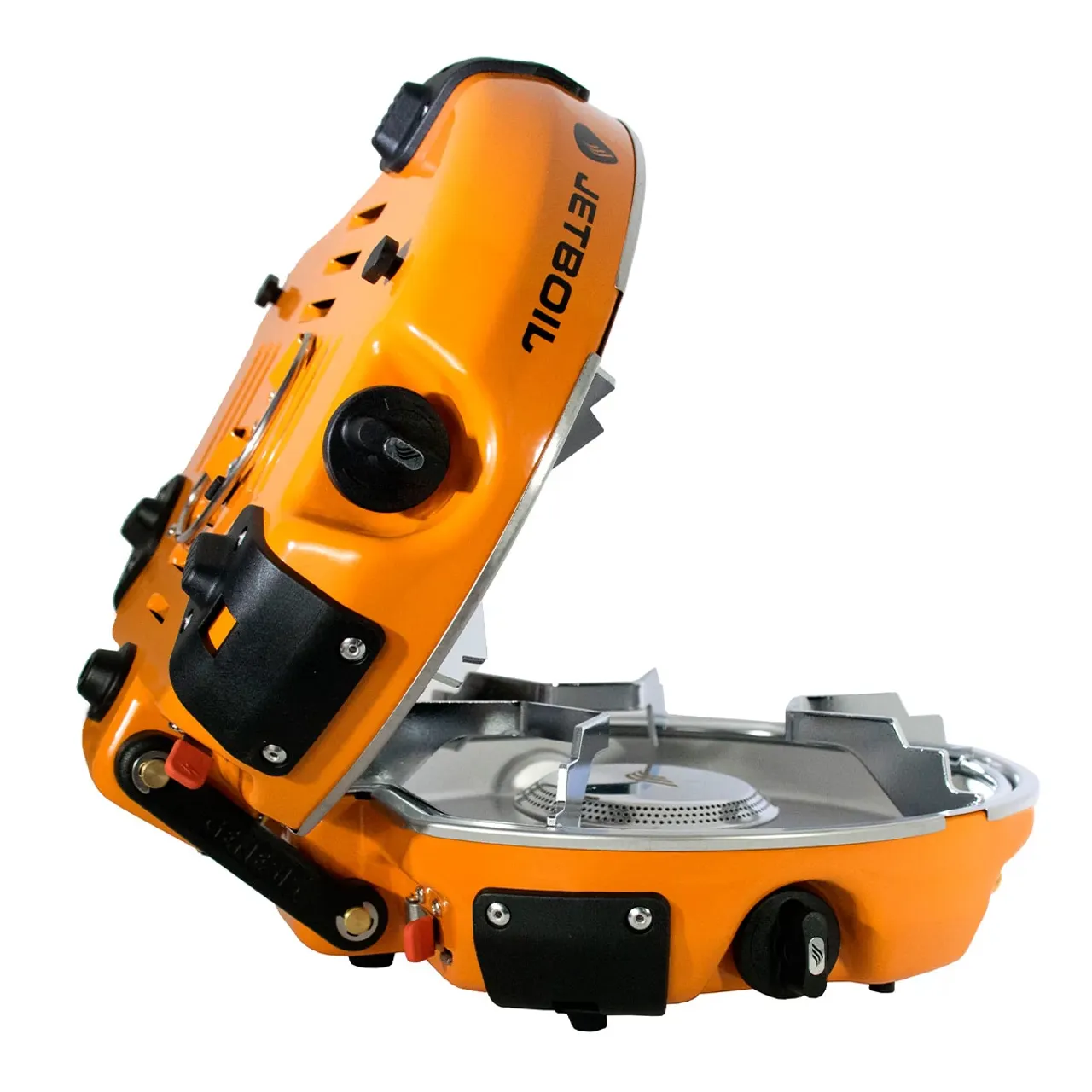
The open stove measures 20.5 by 9.8 inches, leaving useful clearance between the burners. A full FluxPot and the supplied pan can operate side by side without handles colliding. The wide, low stance places cookware much closer to the table than a canister-top burner, which is reassuring with hot liquid and a busy group moving around camp.
I have loaded the grates with heavy pans and never found the hinge loose or the platform tippy. Sensible table choice still matters: a compact stove cannot rescue a folding table on soft, sloping ground. On a stable surface, the frame feels planted and the cookware supports do not encourage pans to skate around.
The raw output is enough for ordinary group meals, but the Genesis is not a commercial cooker. Large-volume frying and rapid heating of heavy cast iron reveal the 10,000 BTU ceiling. Camp cooks who value speed above storage and control may prefer a more powerful box stove.
Wind, fuel and the regulator
Wind is the system's largest performance weakness. The burners sit in shallow wells and remain exposed around the sides. A strong gust stretches the flame, slows boiling and can force higher valve settings. Positioning the stove behind the vehicle, a table-side barrier or another safe shelter improves results.
The flexible windscreen helps and is worth carrying, but its plastic clips are fiddly. Attaching it around a loaded cooking area takes more patience than the rest of the setup. Once fitted, it reduces crosswind without enclosing the propane bottle.
The supplied regulator connects to a standard 16.4-ounce propane cylinder. My hose and regulator have not leaked or failed during three years of use. The stove has also run both burners without pulsing or a noticeable drop in output. The FluxPot's heat exchanger helps stretch each cylinder, especially when much of the trip involves water boiling.
Setup, nesting and portability
Setup takes less than a minute. Release the heavy rubber latch, unfold the clamshell, confirm that the grates are seated and thread the regulator onto the cylinder. The main hinge still moves smoothly and has not developed troubling play.
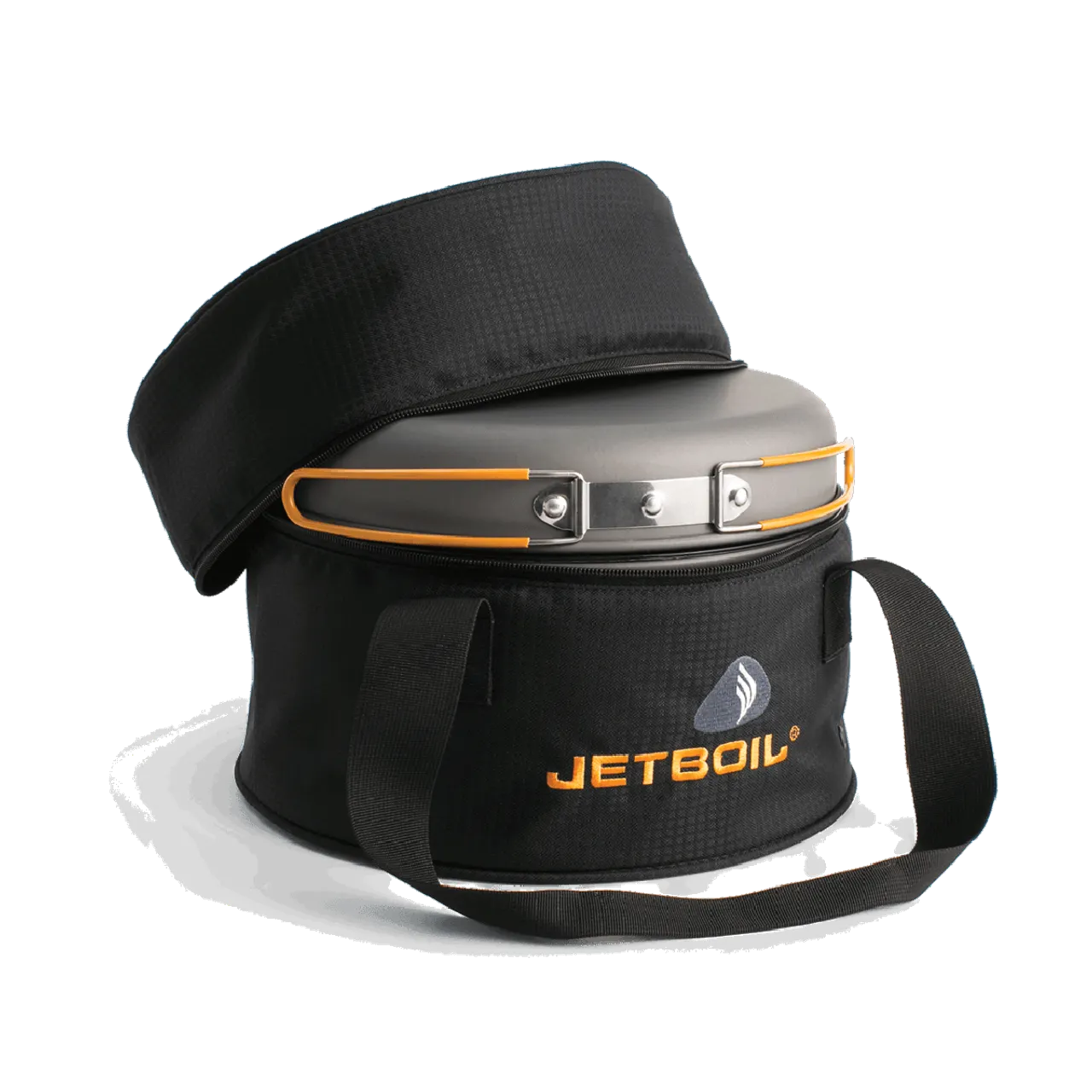
Packing is the clever part. The folded stove nests inside the five-litre pot, the frying pan closes the stack, and the whole system drops into a padded carry bag. Loose components have defined places, so the bag does not become a noisy box of burners, hoses and cookware.
Jetboil lists the stove, pot and pan at 9 pounds 1.6 ounces, excluding the regulator, windscreen and bag. That ends any backpacking argument. It carries comfortably from a vehicle to a table or along a short beach approach, but I would not choose it for a trip where every kilogram lives on my back. Its portability advantage is reduced cargo volume, not low mass.
Cleaning and durability
The stove body, rubber straps, hinge and metal framework have handled frequent packing and ordinary camp knocks well. The grates remain secure and both gas controls still offer the same long adjustment range. The cookware coating has also lasted because I keep metal utensils away from it.
Cleaning is less elegant. Grease, crumbs and boil-overs can fall into the burner wells or hinge. Flat surfaces wipe quickly, but food trapped around the mechanisms takes a brush, cloth and patience. Cleaning soon after a trip is easier than letting grease harden inside the folded stove.
My plastic FluxPot lid warped after exposure to flame overhang. It was avoidable with more careful burner use, yet the lid is part of a system designed to live near fire and I would prefer greater tolerance. The failed igniters remain the larger durability penalty because both stopped serving their intended purpose early.
How it compares
A conventional Coleman two-burner is the budget and simplicity option. It costs far less, accepts rough treatment and is easy to understand, but its suitcase shape consumes more vehicle space. Typical controls also give less room for fine simmering than the Genesis valves.
The Camp Chef Everest 2X takes the opposite approach to power. Its 20,000 BTU-per-burner output and stronger wind performance suit large cookware and exposed camps. The trade is a bulkier box that does not disappear into its own pot. Choose it when heat and wind resistance matter more than packing efficiency.
Two separate backpacking stoves win on carried weight and flexibility. They also create two tall, independent platforms that are less reassuring beneath a five-litre pot or heavy frying pan. They make sense for human-powered travel; the Genesis makes sense when one compact vehicle-supported kitchen must feed several people.
Price and value
I paid $337.49 for the complete system. That is expensive beside a basic two-burner stove, although the comparison changes once a large heat-exchanger pot, coated frying pan and padded bag are added. The Genesis is sold as an integrated kitchen, and its value depends on using that integration.
For three years, it has been the system I choose for car camps and reliable basecamps because it cooks well and packs into an awkwardly small amount of space. That repeated use justifies the price for me. The score still loses ground for the igniters and lid. Premium pricing creates a reasonable expectation that secondary components will last with the burners.
Budget campers who only boil water should spend far less. People with limited vehicle storage, several mouths to feed and an interest in proper cooking will get more from the Genesis than its specification sheet suggests.
Who should buy it
The Genesis is best for vehicle campers, overlanders, canoe trips with generous carrying capacity, festival camps and sailors working from a beach or reliable base. It suits cooks who care about low-flame control, use more than one pan and want their complete setup stored in one compact bag.
Ultralight hikers should avoid it. So should buyers who need maximum performance in persistent wind, want commercial levels of heat or are unwilling to carry a backup lighter. A basic suitcase stove gives better value when packing space is abundant and cooking demands are simple.
I would buy the Genesis again for the same work. Its core burners, controls and frame have survived three years and still solve the problem I bought it for. I would also put a lighter in the bag immediately, shield the stove carefully in wind, keep flame away from the lid and clean the burner wells before grease becomes permanent.
Jetboil Genesis Basecamp specifications
| Tested system | Complete Jetboil Genesis Basecamp System |
|---|---|
| Burners | 2 |
| Output | 10,000 BTU/h / 3 kW per burner |
| Flame adjustment | Four full turns per valve |
| Cookware | 5L FluxRing Cook Pot and 10-inch ceramic-coated frying pan |
| Published boil time | 3 minutes 15 seconds per litre in the 5L FluxRing pot |
| Fuel | Standard 16.4 oz propane cylinder |
| Published system weight | 9 lb 1.6 oz / 4.1 kg, excluding regulator, windscreen and bag |
| Packed dimensions | 10.3 x 7.2 in / 26.2 x 18.3 cm |
| Open dimensions | 20.5 x 9.8 in / 52.1 x 24.9 cm |
| Published group size | 3-5 people |
| Largest group tested | 8 people |
| Price paid | $337.49 USD from Amazon.com |
| Test period | About 3 years across Europe and Canada |
| Brand involvement | None. No product, funding, support or copy approval. |
Scoring breakdown
Sources & context
What we checked
This review is grounded in Adam's three years of use across Europe and Canada. Current output, dimensions, included components, fuel compatibility, published weight and boil time were checked against Jetboil's official specification.
Editorial disclosure: Adam bought the complete Genesis Basecamp System with his own money for $337.49. Gear Reviews received no payment, free product, support or editorial approval from Jetboil.