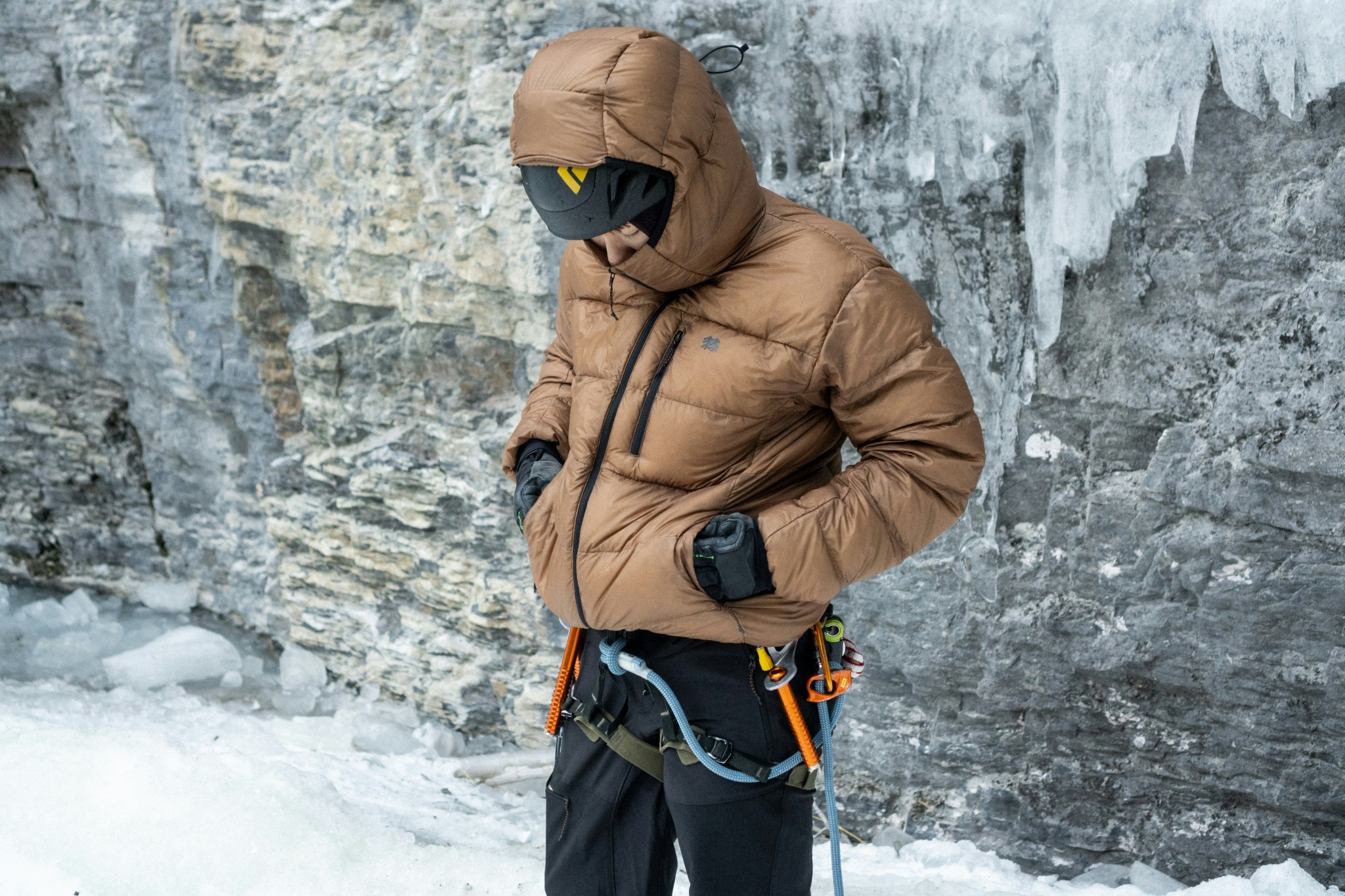
You're looking at two down jackets. One has 900-fill down and costs a small fortune; the other has 700-fill and looks considerably puffier. It's tempting to assume the expensive one must be warmer. But the fill-power number only tells you part of the story, and the amount of down inside can change the comparison completely.
The same confusion follows you into sleeping bags. A high fill power is useful when you're trying to keep a rucksack light, but it doesn't replace the rest of the specification. We'd read fill power and fill weight together, then look at how the jacket or bag puts that insulation to work.
The difference in a nutshell
Fill power describes how much space a given weight of down can occupy in a standard test. Fill weight is the mass of insulation inside the product. Higher fill power gives more "loft" for the weight - volume or "fluffiness" - whereas a higher fill weight means there's more filling. The warmth of the finished item depends on both, along with its construction and fit. [1] [2]
| Specification | What it describes | What to look for |
|---|---|---|
| Fill power, such as 800FP | Loft for a given weight of down | Useful when comparing insulation efficiency and packed weight |
| Fill weight, such as 150g | The amount of filling inside | Compare the same garment size or sleeping-bag length |
| Total weight, such as 400g | The complete item, including fabrics, zips and filling | The weight you'll carry in your rucksack |
What 800-fill down means
Fill power is commonly expressed in cubic inches per ounce. In that measurement, an ounce of 800-fill down occupies 800 cubic inches under the specified test conditions. The ounce is about 28.35g. You'll also see the number written as 800FP or 800 cuin. That 800 is a volume figure, so it doesn't mean the jacket contains 800g of down. [1]
Down clusters open out and hold pockets of air. Higher-fill-power down can occupy more space for its mass, which gives designers a way to build warm insulation with less filling. That's the appeal of the very high numbers on lightweight technical jackets and sleeping bags: they help save weight and packing space. [2]
We'd be interested in an 800- or 900-fill jacket for a trip where every layer has to fit in a small pack. We'd still want to know how much down it contains. A thin, high-fill-power jacket and a heavily insulated winter coat are built for different jobs.
Fill weight tells you how much is inside
A jacket with a down fill weight of 150g contains 150g of its down filling. Its total weight will be higher once you add the shell, lining, zip, pockets and other parts. Sleeping bags make the distinction especially easy to miss because both numbers can be several hundred grams. [3]
For jackets of similar size and construction, the amount of down is a useful clue to warmth. A lightly filled 900FP jacket can be less warm than a much more generously filled 700FP jacket. The expensive down helps the lighter jacket deliver its warmth with less weight; it doesn't turn a small quantity into unlimited insulation. [3]
Size needs a little attention here. A long sleeping bag has more area to insulate than a short one, and a large parka has more to cover than a small waist-length jacket. We'd check which size the published fill weight refers to before comparing the numbers. If a brand only gives total weight, we'd ask for the down weight rather than trying to work it out from a photograph.
A worked example: 900-fill versus 600-fill
Imagine two batches of down, both assessed using the same fill-power method. One weighs 100g and has a fill power of 900. The other weighs 150g and has a fill power of 600.
| Illustrative batch | Fill power | Fill weight | Calculated test volume |
|---|---|---|---|
| A | 900FP | 100g / about 3.53oz | About 3,175 cubic inches |
| B | 600FP | 150g / about 5.29oz | About 3,175 cubic inches |
The calculation is fill weight in ounces multiplied by fill power. The two batches work out at the same test volume, with 50g less filling in batch A. That's a useful illustration of why someone carrying all their equipment might pay for higher-fill-power down.
Inside a jacket, that filling has to occupy real chambers of a particular shape and depth, spread across the body and sleeves. A sleeping bag has a different area to cover again. The calculation describes the down's test volume; a temperature comparison needs the finished products.
Baffles, coverage and fit finish the job
The chambers holding the down are called baffles. Their shape and depth control where it can expand and how well it stays distributed. Stitch-through construction joins the inner and outer fabric along the seams. Box-wall construction uses internal partitions to keep those fabrics separated and reduce thin spots along the stitching. [4]
Distribution can also be deliberate. Rab describes putting different amounts of down into different areas of a sleeping bag, including extra insulation around the torso and foot box. Two bags with the same total fill can therefore put it in different places. [4]
For a jacket, we'd look beyond the torso: hood coverage, collar, cuffs and hem all affect how enclosed we feel when standing around. We'd try it over the layers we expect to wear and check that reaching forward doesn't pull everything tight.
Adam's Rab Mythic G review is a useful example of the complete garment. His medium has a listed total weight of 277g and uses 1000-fill-power down. After about four months of almost daily wear in Megève, he particularly liked its warmth when stationary and its small packed size. On sustained uphill walks he soon wanted it off. He also noticed cold spots along the stitched baffles in biting wind. Those observations tell us far more about when he'd wear it than the 1000FP label on its own.

For sleeping bags, compare temperature ratings too
With a sleeping bag, we'd narrow the choice using the temperature rating, then compare the weight and packed size of bags suited to the trip. Where brands provide EN ISO 23537 results, compare the same rating: comfort with comfort, or limit with limit. Comparing one bag's comfort figure with another's limit makes the second look warmer than an equivalent comparison would. [5]
The extreme rating is an emergency survival figure, so we'd leave it out of a comfortable-night buying decision. The bag's fit, hood and draught control also deserve attention. Rab's testing explanation describes both laboratory ratings and the effects of the sleeping setup and the person inside it. [5]
Once two bags offer the warmth and room we're after, fill power becomes a useful way to understand differences in their insulation weight. We'd then compare total packed weight, zip length and fabric as well. A wonderfully light bag loses some appeal if its cut is too cramped to sleep in.
Include the mat in that decision. Our sleeping mat buying guide explains how insulation underneath works with the bag above.

90/10 down and synthetic fill mean something else
A 90/10 down-to-feather ratio describes the proportions of down and feather in the filling. It is separate from both fill power and fill weight. Down consists of fine clusters underneath the bird's outer feathers; feathers have a different structure. Rab explains the ratio alongside the type of down it uses. [6]
The Responsible Down Standard deals with animal welfare and traceability. An RDS label answers a sourcing question; the fill specification answers the insulation question. [6]
Synthetic insulation needs a different comparison. Our Marmot Wraptor 30 Synthetic review, for example, covers a bag using synthetic sheet insulation. Its useful specifications include the ISO temperature ratings, complete weight and packed size. There is no down fill-power figure to compare with an 800FP bag.
Where we'd spend the extra money
For backpacking, paying for high fill power can make sense once the jacket or bag has enough insulation for the job. Weight and bulk stay with you throughout the walk, and the worked example shows how a smaller mass of high-loft down can earn its place.
For campsite use beside the car, we'd be happier accepting a heavier, bulkier item if it gives us the warmth, fit and price we want. A premium fill-power number would come further down the list.
Our comparison would come back to four things: the conditions and activity, the amount of filling in the right size, the way the item fits and is constructed, and the complete weight and packed size. Fill power helps explain the trade; it doesn't make the choice for us.
And if a jacket you already own has gone flat, a higher specification isn't necessarily the answer. Our guides to washing a down jacket and restoring its loft and washing a sleeping bag cover cleaning, drying and storage before you retire useful kit.
Sources and further reading
Technical explanations behind this guide
The definitions and construction advice draw on the manufacturer documentation below, checked on 4 November 2026. The Mythic G observations come from Adam's published field review. The two down batches in the worked example are illustrative.
Our full guide to sleeping bag comfort, limit and extreme ratings works through two example labels and explains which figures we'd compare for a night at camp.
Still choosing between fillings? Our down versus synthetic insulation guide compares pack space, damp-weather performance, care and cost for jackets and sleeping bags.